Board games were woven into everyday life in ancient Rome. Now, thanks to a collaboration between Vindolanda Charitable Trust and Newcastle University, 3D printing means we can play Roman Britain’s most popular game like never before.
Contents:
- Board gaming in ancient Rome
- What sort of board game was unearthed at Vindolanda?
- How to play Ludus Latrunculorum
- Bringing history to life with 3D printing
- Skill-sharing between Vindolanda and Newcastle University
- Vindolanda: a world of gaming, Roman life, and empire
Board gaming in ancient Rome
Board games were a vital part of Roman society, played by all social classes, from enslaved individuals to the Emperor. Many resemble games still played today, such as Duodecim Scripta and Ala, which are likely the ancestors of modern backgammon.
Other games, especially those played with dice are mysterious to us because we have no records of their rules. Nevertheless, we know that games of chance using dice or knucklebones and board games were commonplace across the Roman Empire.
To try to understand the rules of unearthed board games, archaeologists bring together clues from ancient authors such as the poets Ovid and Martial, and material evidence such as gaming boards, gaming pieces, and dice to understand how people played games in the past.
Archaeologists have found gaming boards and other gaming-related artefacts across Roman Britain, with towns, villas, villages, roadside settlements and military sites all providing different levels of evidence. Analysing the kinds of places where gaming kit is found also allows archaeologists to understand who was playing board games.
What sort of board game was unearthed at Vindolanda?
In 2019, archaeologists at Vindolanda excavated a board for Ludus Latrunculorum, also known as ‘the game of little brigands or soldiers’. It was the most popular board game in Roman Britain. Experts found it between a bath-house drain and a workshop wall, beside a late third-century road.
Between 1,500-5000 people would have lived at Vindolanda at any one time, but this population was not exclusively military. It included large numbers of women, children, traders and slaves. These multi-cultural people had access to goods which were imported from all over the empire, including spices from Arabia, amber from the Baltic and olive oil and wine from the Mediterranean.
The fact that the game was found outside of a fort reveals that it wasn’t just a soldier’s pastime. Women, children, and the wider civilian community were playing the game, too. It was a game for everyone.
In subsequent years, the board was repurposed as flagstones for a farm built on the same site. This was a common use for found Roman stone at the time.

Original Roman game board artefact (excavated in 2019), found in the ground.
How to play Ludus Latrunculorum
While the rules for this historical game have never been discovered, what we do know is that it is an ancient Roman strategy game for two players, similar to modern draughts. However, thanks to archaeological evidence, we do have some idea of what the rules might be.
It can be played on any gridded board, though traditionally would be played on square or rectangular boards of between seven and twelve squares across.
Players use their "soldiers" to trap enemy pieces, with the ultimate goal of immobilising their opponent or capturing their special King piece.
Bringing history to life with 3D printing
The game is currently on display in Toronto's Bata Shoe Museum as part of the exhibition 'Unearthing Vindolanda: Footwear from the Edge of the Roman Empire', which will run throughout 2026 and 2027.
But before the game was sent to Canada, the team at Vindolanda reached out to Newcastle University staff Paul Watson, Electrical & Electronic Team Leader, and Dr Jenny Olsen, Lecturer in Mechanical Engineering.
The hope was that it would be possible to scan and 3D print a realistic replica of the Roman game board using the University’s cutting-edge facilities.
The board was escorted to the Stephenson Building by Vindolanda staff Sophie Westlake (Activity and Diversity Officer) and Barbara Birley (Senior Curator).
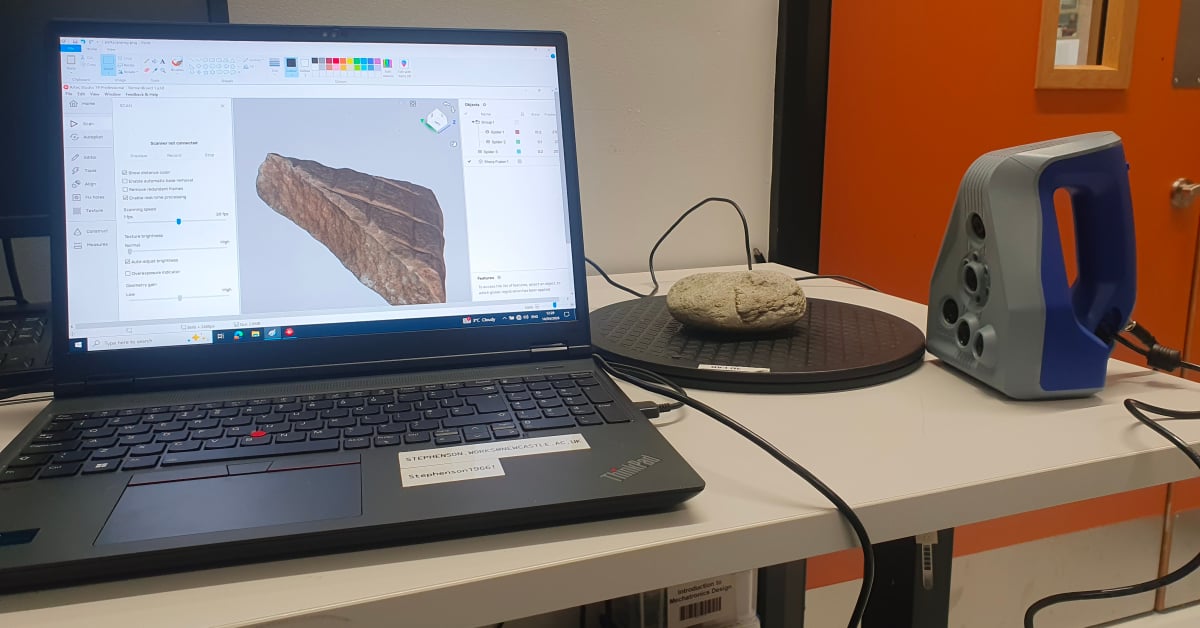
The original Roman board consisted of five separate stone pieces, which joined together to form the complete game board. Each of the individual pieces was scanned separately using the University’s handheld high resolution 3D scanner - Artec 3D Spider. This generated a dataset of object positional points that allowed the scanning algorithm to form a realistic 3D model of the scanned object, before the pieces were printed using Polylactic Acid plastic (PLA), a biodegradable material.


-1.jpg?width=1200&length=1200&name=New%20Project%20(49)-1.jpg)


Skill-sharing between Vindolanda and Newcastle University
The project is an example of meaningful cross-collaboration across sectors that might not otherwise meet. The team took advantage of the opportunity for skill-sharing in both directions.
The Newcastle team demonstrated the object scanning setup and methodology to Vindolanda’s staff, allowing them to personally scan individual pieces of the Roman game board themselves.
The process also proved to be a hugely successful learning experience for the experts at Newcastle University’s School of Engineering. The team learned how to utilise the 3D scanner for real-world problems, and later these skills were transferred to help train internal Newcastle University staff on how to use the equipment for other related engineering projects. The realism and detail of the resultant Roman board model demonstrated the recent advancements in 3D scanning and 3D printing, and how far the technology has developed over a short time.
Once the 3D game replica was produced, it was handed over to Vindolanda Charitable Trust to be used as part of a public engagement programme at The Roman Army Museum. The model will bring this history to life for visitors, allowing them to physically play the ancient game on a replica of the original board – an experience that goes far beyond the display case.
‘It was amazing to be involved in the actual scanning process and to see something so complex and historical be realistically recreated. It will be very beneficial for the Vindolanda Trust to have a replica Roman game board and 3D interactive model, both whilst the original Roman board is on loan and to create a more engaging, tactile experience for the visitor.’ – Sophie Westlake, Activity & Diversity Officer
An interactive 3D computer-based model of the scanned Roman board was also created using the original scanned 3D models – allowing museum visitors to explore all sides of the model by zooming in and rotating it.
The relationship between Vindolanda and the Newcastle staff has also resulted in ongoing discussions about creating a range of joint student projects for Undergraduate courses. Having a real-world problem to solve with engineering skills offers students the chance to physically experience the results and benefit from genuinely rewarding outcomes.
Vindolanda: a world of gaming, Roman life, and empire
From children's shoes to gaming boards, the Vindolanda Roman Fort collection shows visitors how military life intersected with family life at the frontier community. Vindolanda holds around 15% of all gaming boards found in Roman Britain, 16 boards in total, making it the largest collection in the country.
The material culture left by the people of Vindolanda constitutes one of the greatest and most diverse single site Roman collections from anywhere within the Empire. Vindolanda gives direct physical and intellectual access to objects that throw a blinding light on the period from the site’s foundation in c.85AD to its final abandonment, sometime in the 9th century.
Finds from Vindolanda’s collections have radically improved understanding everyday life on the Roman Frontier. The collection includes many items which reveal the Roman communities’ understanding of technology, architecture, language, government, town planning, their views of national matters and their own personal identity. Some highlights include writing tablets, thousands of boots, shoes, jewellery, armour, weapons and tools.
You might also like:
- find out more about the work of Vindolanda Charitable Trust
- explore a world of board gaming at Vindolanda
- discover Newcastle University’s School of Engineering
- read the blog: How are researchers uncovering hidden maths from ancient Rome?
- explore the project: What can Cicero and the ancient past teach us about corruption?
