12 May 2026 | By: Dr Marta García Morcillo, Lecturer in Ancient History and Dr Nick Freer, Lecturer in Classics | 9 min read
-2.jpg)
The Roman statesman Cicero might have lived over 2,000 years ago, but his works and the society they describe are as relevant now as ever.
Find out from Dr Marta García Morcillo, Lecturer in Ancient History and Dr Nick Freer, Lecturer in Classics, what can we learn today about the ancient Romans’ ideas of integrity and civic responsibility, and their experience with the long shadows of corruption.
Contents:
- Who was Cicero, and why does he matter today?
- Cicero’s thinking around corruption
- Corruption in the Spotlight: the thinking behind the project
- Cicero versus Verres: understanding citizenship
- Discussing ancient (and modern) corruption in the classroom and on the stage
- What did the Verres case re-enactment show?
- Could the students find a way to defend Verres?
- How do we solve the problem of corruption?
- Corruption’s long way: the case of Verres and the present day
Who was Cicero, and why does he matter today?
Born in 106 BCE, Marcus Tullius Cicero was a key figure of the Roman Republic, and one of the witnesses and protagonists to its decline and fall.
A statesman, lawyer, scholar, philosopher, orator, and writer, Cicero’s works and thoughts have transcended his own times. They stand as persistent reminders of the idea of history as teacher of life and vibrant echo of the present.
Cicero’s writings include works of rhetoric, orations, philosophical, and political treatises, as well as personal letters that both showcase his public persona and reveal his most intimate thoughts and emotions. Taken together, these are invaluable sources for the understanding of past ideals and motivation, of the function (and malfunction) of public institutions, of perceptions of political and moral crises, and of the conflicts between political ambition and honesty.
Modern strategies of persuasion (and manipulation) in oratory, at court, in parliament, and in twenty-first century digital global media are heavily influenced by the form and content of Ciceronian speeches and rhetoric.
Cicero’s thinking around corruption
What can we learn from the views on corruption and wrongdoing and the moral dilemmas of people living more than 2000 years ago? Are our ethical standards and concerns so different from those of ancient Greeks and Romans?
Corruption is one of those things that we think we understand but often struggle to define. When we think about corruption, we often focus on the scandals of politicians and the crimes of corporate finance. And yet, as history insists on telling us, corruption concerns not just ‘others’, but all of us.
But how is that so?
In essence, corruption requires the transfer of a material or immaterial thing (for example, a gift, a position, an advantageous deal, a favour), as well as its identification as legally or morally wrong by a mistrusting observer. Very often, those actions test the limits of our self-interest and the values that define our relationship with others. Ultimately, they make us think about what it means to be a good citizen in democratic (and non-democratic) societies.
Cicero’s works and his own life experience present striking cases of wrongdoing and abuses of power – including embezzlement, bribery, extortion, and fake news – that find stunning parallels in our modern world. But they also alert us to the grey zones that often surround daily ethical challenges, decision-making, and their justification.
For instance, Cicero’s philosophical treatise 'On Duties (De Officiis)' (44 BCE) is not concerned with individuals who are publicly condemned for any crime, but rather with citizens who, despite their reputation for honesty, are tempted by self-interest and confronted with complex moral dilemmas that test their integrity.

Image: Portrait of Cicero, engraving from K.A. Baumeister, Denkmäler des klassischen Altertums I, 1885, p. 396. Free domain.
Corruption in the Spotlight: the thinking behind the project
Gaius Verres (c. 114-43 BCE), who had been provincial governor (propraetor) of Sicily for three years, was prosecuted in Rome in the summer of 70 BCE.
Verres’ career was cast in the shadow of suspicion.
By 78 BCE, he had been accused of plundering the province of Cilicia (southern coast of Asia Minor, Turkey) while serving as senior officer of the governor, but he was exonerated after reporting the governor for these crimes.
Owing to the support of the Senate, he managed to obtain another important public office in 74 BCE: the praetorship of the city of Rome. Suspicion of abuses did not prevent his election for the attractive position of governor of Sicily in 73 BCE.
But was Verres really corrupt or just someone with a bad reputation and many political enemies? Did he really bribe, abuse, and plunder, or did he simply give and receive many gifts?
These intriguing questions are explored in a groundbreaking project that engages young people with morality, ethics, and corruption—not just in the ancient past, but in the present day, too.
'Corruption in the Spotlight' is an educative and creative project, led by ourselves, Dr Marta García Morcillo and Dr Nick Freer, which focuses on Cicero’s speeches and trial against Verres in 70 BCE, possibly the most famous court case of corruption from antiquity.
The project springs from the Arts and Humanities Research Council (AHRC) and Deutsche Forschungsgemeinschaft (DFG) UK-German initiative Twisted Transfers: Discursive Constructions of Corruption in ancient Greece and Rome (20-24), co-led by Dr Marta García Morcillo, Dr Shushma Malik from the University of Cambridge, and Professor Filippo Carlà-Uhink from the University of Potsdam. Corruption in the Spotlight is a collaborative initiative between the School of History, Classics for All North, ClassicsFest (at the Lit & Phil, Newcastle), and Sixth Form students and teachers from schools in North-East England.
The project aims to understand the impact of ethical values and moral dilemmas in Ancient Greece and Rome and why they matter today. The project has led to the creation of a new book series: 'Twisted Transfers: Studies on Ancient Corruption', directed by Filippo Carlà-Uhink and Marta García Morcillo.
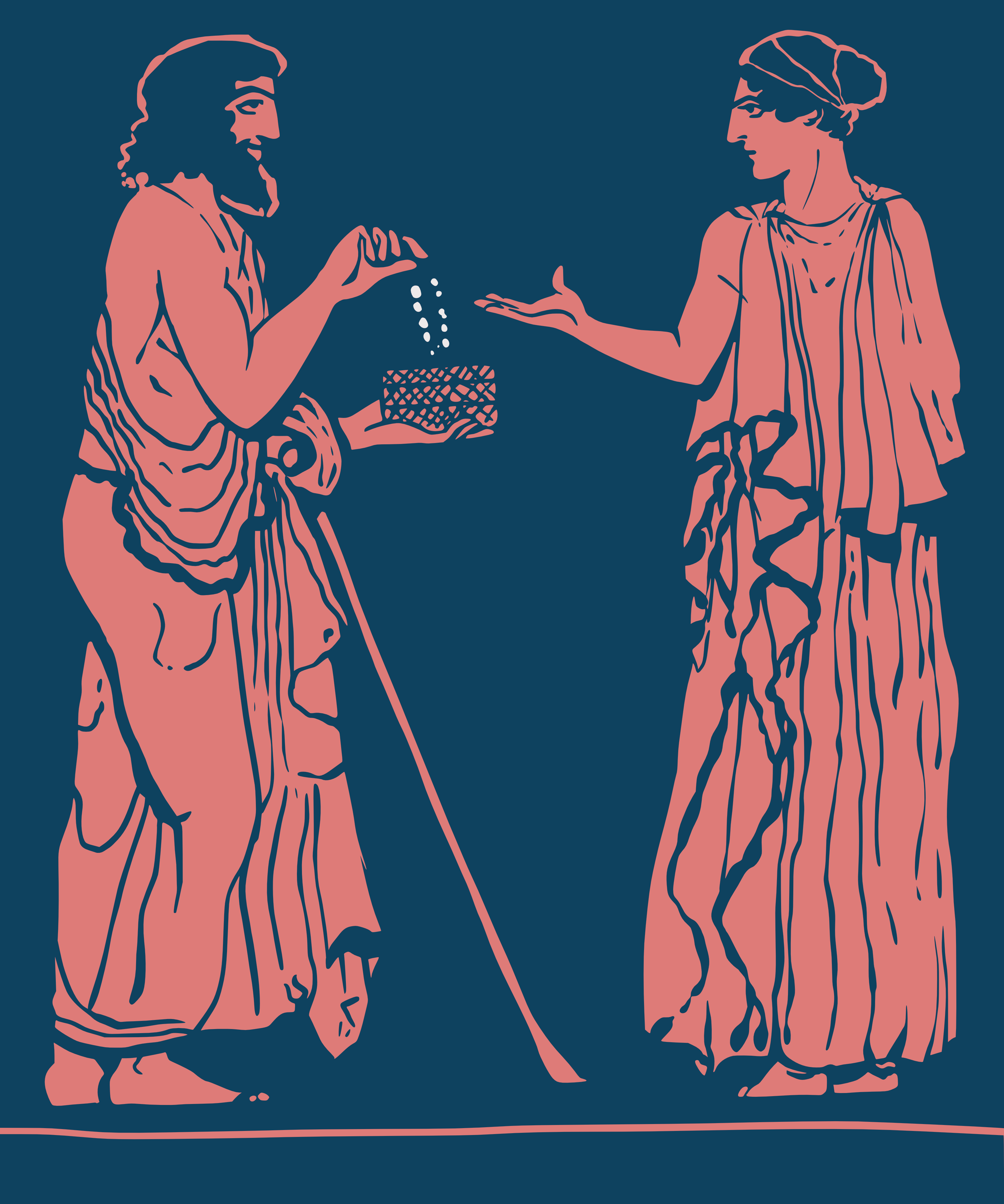
Logo of the project Twisted Transfers. © Michael Fetzer
Cicero versus Verres: understanding citizenship
While the initial focus of the project revolves around Cicero’s ‘Speeches Against Verres’ (70 BCE), the goal of this collaborative initiative is to create useful learning and teaching tools and methodologies that deepen our knowledge of values linked to citizenship, and allow us to better understand how social and ethical norms have developed and changed throughout history.
Ultimately, the ongoing project seeks to broaden our awareness of corruption as a persistent problem that concerns not only political systems and institutions, but also private individuals and communities.
The pilot project, which took place between January and May 2025 in collaboration with ClassicsFest and Classics for All North, recruited about 50 Sixth Form students from schools across North East England. They took part in a series of workshops and in-class activities relating to the Verres trial, one of the most exhaustively documented court-cases against corruption in history. The speeches allow us to explore, from the perspective of the prosecutor, different forms of wrongdoing and misbehaviour linked to the role of statesmen and public magistrates, as well as social norms and values associated with citizenship.
The long list of charges levied by Cicero against Verres as governor of Sicily provides many examples of corruption that are transferable to the modern world: from embezzlement to bribery and extortion, from abuse of authority to the manipulation and forgery of public accounts and documents, from false testimony to tax-fraud and the unlawful imprisonment of citizens.
-3.jpg?width=1200&height=628&name=New%20Project%20(38)-3.jpg)
Removal of the Statue of Verres in Centoripi (Sicily) by order of the senate. Engraving by Tomaso De Vivo (1790-1884). Public domain.
Discussing ancient (and modern) corruption in the classroom and on the stage
'Corruption in the Spotlight' engaged the young participants in a critical debate about the roots of corruption and moral wrongdoing, both in the past and in the present, as a phenomenon linked to the creation (and transgression) of social norms and collective ideals.
The creative side of the project aimed to test the absolute timeliness and universality of the themes and moral considerations of the Verres trial and of Cicero’s Speeches.
Following the workshops, co-led by Dr Laura Hope, the Network Co-ordinator for Classics for All, the students responded to the issues raised, discussed their contemporary parallels, and proposed ideas for the creation of a case for the defence (which does not survive from antiquity).
All of these ideas were then integrated by the poet and writer Kirsten Luckins into a new play that reimagined the trial with a stimulating contemporary flair.
-2.jpg?width=1200&height=628&name=New%20Project%20(39)-2.jpg)
Corruption in the Spotlight. Cicero vs Verres. Trial. Eliís Konstantina as Hortensius © Jason Thompson @Sound Ideas Media and ClassicsFest.
The play, directed by Cinzia Hardy and performed by professional actors – with Professor Deveral Capps, Professor of Law and Dean of Leeds Law School, as judge – was performed on May 16, 2025 (Newcastle, The Common Room). The play (and trial) concluded with a vote by the audience, which included the students who participated in the project, acting as the popular jury.
The video recordings of the trial and the following panel discussion, with the writer Kirsten Luckins and Classicist and Cicero expert Dr Kathryn Tempest (University of Leicester), are accessible here: 'Corruption in the Spotlight' I: The Trial; 'Corruption in the Spotlight' II: Panel Discussion.
Corruption In The Spotlight: Cicero versus Verres - The Trial. This performance reimagines the historical trial of Gaius Verres, the corrupt Roman governor prosecuted by Marcus Tullius Cicero in 70 BC.
What did the Verres case re-enactment show?
The transformative, educational, and creative ethos of 'Corruption in the Spotlight' was captured in the responses provided by the students to a series of key questions revolving around the project and its further significance.
‘What kind of leader is that? One that aims to turn power and responsibility into a profitable business?’ – Sixth Form student and participant in the project, Durham Sixth Form Centre
The Verres case shows how lawfare – or the manipulation of justice to villainous ends – has been a problem for societies both ancient and modern. The workshop initiated discussion of complex topics, such as the checks and balances of legal systems and the menace of corruption. What happens when judges and the administration of justice are cast under suspicion?
In the background of the Verres trial, Cicero questioned the entire system of the extortion courts in Rome, which were at that time highly politicised institutions that were controlled by the aristocratic elite. The main purpose of the extortion court was to keep a check on expenditure and to prevent abuses by governors in the provinces.
‘[The case] made me question the Roman Republic and its political structure’. – Sixth Form student in the trial audience/jury
In the Roman world, the governor of a province was also the main judge, which would be labelled as a conflict of interest today. The irregularities of which Verres was accused were arguably a direct consequence of the excessive accumulation of power by figures in Roman public office.
'It has made me question where the line is and how far corruption led to the fall of the Roman Republic.’ – Sixth Form student in the trial audience/jury
-2.jpg?width=1200&height=628&name=New%20Project%20(40)-2.jpg)
Corruption in the Spotlight. Cicero vs Verres. Trial. Wambui Hardcastle as Cicero © Jason Thompson @Sound Ideas Media and ClassicsFest.
Could the students find a way to defend Verres?
One of the major difficulties confronted by modern readers of the Verres trial is that we only have the speeches of the prosecution, which present him as an unscrupulous, self-serving criminal—a menace to the Republic itself.
And yet, everyone should have the right to a fair trial, shouldn’t they?
We asked the students to consider critically the following questions: can Cicero’s characterisation of Verres be trusted? If not, could Verres be defended in any way?
The Sixth Form students tried to place themselves in the shoes of the defendant and to consider the responsibilities, priorities, and decision-making challenges that all rulers face. For one student, ‘Verres actions were necessary to maintain order or ensure the smooth functioning of the province’. Order and the rule of law as legitimating arguments for harsh actions and unpopular decisions were discussed by the students as a possible strategy for the defence.
More difficult to justify was Verres’ unlawful arrest of Roman citizens accused of treason. Is it wrong to arrest someone in order to prevent social unrest and rebellion? The reasoning of the students is important because it reminds us that true justice is not a matter of political expediency but a fair evaluation of the facts and evidence. Why not question also the credibility of Cicero’s witnesses or the accuracy of the financial reports that were used by the prosecutor to demonstrate Verres’ crimes? Could the accusations of tax fraud be politically motivated, with the purpose of damaging Verres’ reputation?
How do we solve the problem of corruption?
'Accountability and transparency are key.’– Sixth Form student participant in workshop
This response to the question of how to solve the problem of corruption encapsulated the view of a good number of students, who identified the need to reinforce the mechanisms of checks and balances in public institutions.
The question of how to achieve this goal in turn generated a range of further responses.
Some students discussed the need to reform the law, while others saw the need to address the problem at its very roots, which are connected with structural issues of social unfairness and inequality.
'Solving corruption, for me, would begin with ensuring everyone has a fair deal and is treated equally in the eyes of the law but also in society.’ – Sixth Form student participant in workshop
Education was identified by several students as a powerful tool to reduce the risk of corruption.
‘Corruption starts with one’s morals, so the best cure would be to start with ensuring children are taught proper values of fairness and honesty.’ – Sixth Form student participant in workshop

Corruption in the Spotlight. Cicero vs Verres. Trial. Discussion Panel (Marta Garcia Morcillo, Kirsten Luckins, Kathryn Tempest and Laura Hope) © Jason Thompson @Sound Ideas Media and ClassicsFest.
Corruption’s long way: the case of Verres and the present day
The participants shared the view that contributing to the workshops and the modern play helped them better understand the complexities of the issue of corruption and its status as a human problem that transcends periods and societies.
'The deep roots of corruption in the ancient world’ and the ‘similarities with the current political landscape’ were key takeaways from the experience.
The students further highlighted that the Verres’ case revealed very uncomfortable truths that resonate strongly today:
‘Maybe sometimes powerful people feel they have to act corruptly as a means to an end.’ – Sixth Former student (trial audience/jury)
The ‘long way of corruption’, as put it by one student, should by itself be an important reason to openly discuss this historical problem that affects us all.
The involvement of the students in this creative process, the ability of Kirsten Luckins to capture the ideas and concerns discussed in the workshops, and the actors’ and director’s success in bringing the play to life on stage in a thrilling performance showed the modern spirit of this historical case and its transformative power.
The success of this fulfilling experience will inspire and guide the next steps of this initiative. 'Corruption in the Spotlight' aims ultimately to demonstrate why creative and educative projects that use the lens of the past are powerful instruments to strengthen our democratic values today.
-1.jpg?width=1200&height=628&name=New%20Project%20(41)-1.jpg)
Corruption in the Spotlight. Cicero vs. Verres. Trial. Audience, detail © Jason Thompson @Sound Ideas Media and ClassicsFest.
You might also like:
- explore the AHRC/DFG UK-German collaborative initiative Twisted Transfers: Discursive Constructions of Corruption in ancient Greece and Rome (20-24), co-led by Marta García Morcillo and Filippo Carlà-Uhink (University of Potsdam)
- find out more about Dr Marta García Morcillo, Lecturer in Ancient History at Newcastle University’s School of History, Classics, and Archaeology
- find out more about Dr Nick Freer, Lecturer in Classics at Newcastle University’s School of History, Classics, and Archaeology
- discover the book series: 'Twisted Transfers: Studies on Ancient Corruption', directed by Filippo Carlà-Uhink and Marta García Morcillo
- looking for more stories about the lives of the Romans? Discover how researchers are uncovering hidden maths from ancient Rome
- find out more about the ancient world, and how a 5,300-year-old bow drill is rewriting the story of ancient Egypt
- discover how we’re connecting more children with the past through a unique video game
