
Bank branches and supermarkets do more than provide services. They bring customers, workers, lighting, security, and activity to a high street – and their closure can have huge consequences for the surrounding area.
In a new study, Professor Nils Braakmann and Dr Diego Zambiasi from Newcastle University Business School investigate what happens to crime and local economic activity when major high-street businesses close.
Contents:
- What is an anchor business?
- Why might a shop closure affect crime?
- How can we identify the effects of closures?
- What happens to crime?
- The effects are extremely local – and take time
- What else changes in the neighbourhood?
- What does this mean for the future of the high street?
What is an anchor business?
The decline of the British high street has been discussed for years. In many areas, boarded-up shops have replaced once thriving branches of major chains. Banks have disappeared as more and more customers used online services, while supermarkets and retailers have been lost to online shopping and home deliveries.
These closures have obvious direct consequences: Customers may have to travel further to access a service, employees may lose or change their jobs, and high streets might change their identity when well-known brands are replaced by an empty unit, bookies, or vape shops.
But large shops can also play a less visible role in their local area.
Banks and supermarkets are examples of what urban economists sometimes call anchor businesses. These are shops that people regularly visit and that help to draw people into an area.
Once there for their weekly grocery shopping trip or banking appointment customers might also visit neighbouring shops, nip to the local butcher or baker, buy a coffee from a local café, or have lunch at a deli or restaurant.
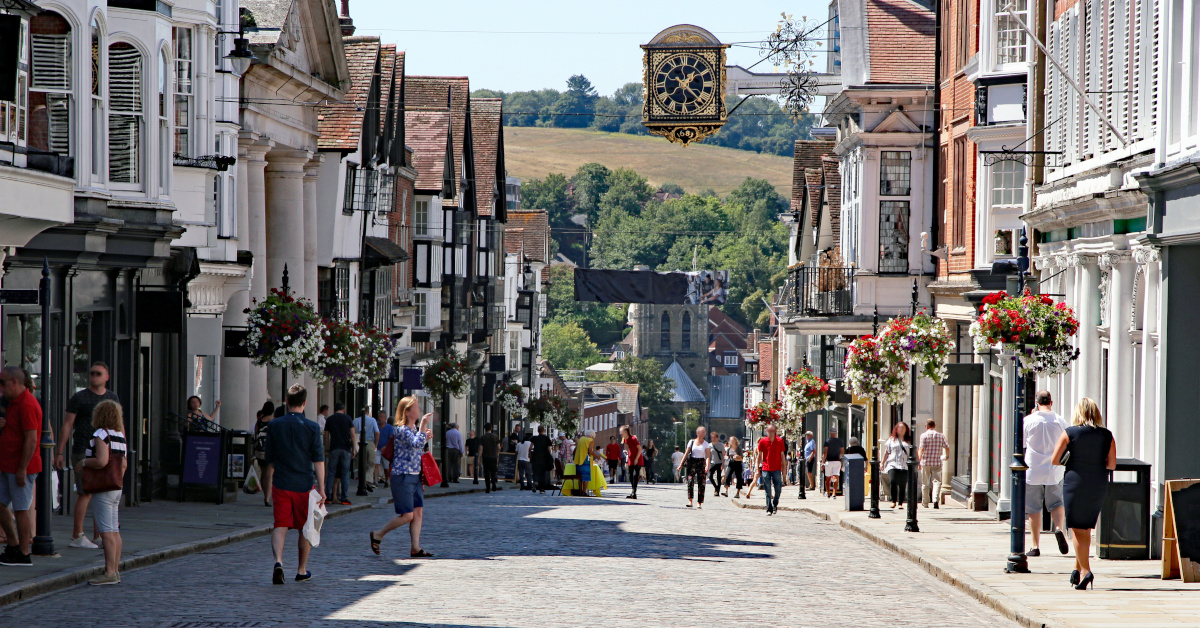
High streets are more than collections of shops: they are places where commercial and social activity come together.
Why might a shop closure affect crime?
Major businesses also provide a form of social order: They employ staff and sometimes guards, generate pedestrian traffic and often provide lighting, CCTV and other forms of security.
For crime, these effects are theoretically ambiguous. More people and businesses create more potential targets for crime. At the same time, they also create what a prominent criminological theory (Routine Activity Theory) calls ’capable guardians‘: shop workers, customers, passers-by and security staff who all might potentially intervene when someone commits a crime.
Closing an anchor shop removes some of both. It may reduce opportunities for offences such as shoplifting, but it may also make an area quieter, reduce informal surveillance, and make other types of offending easier.
There is also a potentially more important longer-term effect. If an anchor business brings customers to an area, its closure could make some of those neighbouring shops and businesses less viable – the butcher or baker relying on people picking up sausages and bread during their weekly shopping trips lose out, as do neighbouring cafés, delis and restaurants. What begins with one bank branch closing could therefore turn into a gradual decline in commercial activity and potentially the broader appeal of an area.
Which of these effects actually occur is an empirical question that can be tested with data.
How can we identify the effects of closures?
The obvious difficulty is that shops do not close randomly.
For example, bank closures might be more likely in already declining areas that are avoided by customers. Alternatively, we could also imagine that closures are more likely to occur in prosperous areas where more people have switched to online banking. Because of these factors, simply comparing areas with and without bank closures does not tell us very much.
In our study, published in the Journal of Urban Economics, we use a combination of very detailed geographical data and a specific research design to get around this problem.
We construct a monthly dataset covering all 181,373 Census Output Areas in England and Wales between 2015 and 2018. Census Output Areas are large enough for Census statistics to be released without infringing confidentiality, but are still the smallest and lowest level of geographical building blocks for collecting, publishing, and analysing official census statistics. On average they contain only around 227 people, which allows us to examine changes at something close to street level.
Our main analysis focuses on mass closures, where the same bank closes at least ten branches in the same month. Between 2015 and 2018, 1,365 branches were closed as part of such programmes.
The underlying idea is fairly simple. A bank deciding centrally to close dozens of branches across the country in the same month is much less likely to be responding to a sudden change in crime on one particular street.
We then compare crime changes in areas directly affected by a closure to developments in other areas over the same time period, using a design economists call ‘difference-in-differences’. We subject our estimates to a fairly extensive set of robustness checks. For example, we use different definitions of mass closures, different statistical methods, different ways of accounting for local trends – such as allowing areas to trend differentially based on pre-closure characteristics or allowing different cities or larger neighbourhoods to trend differently – and a specific large closure programme involving NatWest and RBS. In our most demanding specifications, we are effectively comparing tiny areas with and without closures within the same neighbourhood in the same month.
We also repeat the basic analysis using supermarket closures, which affect different places at different times.
The results are remarkably consistent.
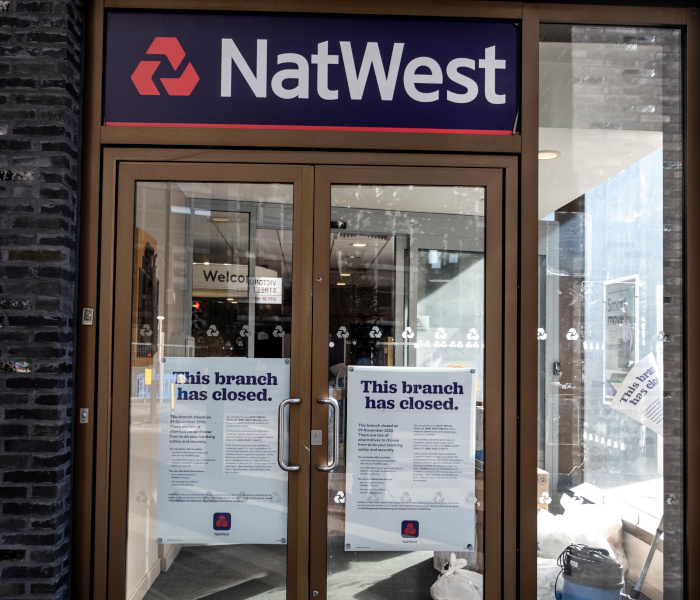
Mass closures of banks had a significant effect on crime in those areas.
What happens to crime?
Crime increases after an anchor shop closes.
Across our main specifications, bank closures lead to roughly 0.5 to 0.7 additional recorded crimes per 100 residents per month. An especially conservative specification, which is likely to absorb some of the longer-term effect we are interested in, produces a smaller estimate of around 0.2.
These are substantial changes. Areas containing bank branches already have more crime than the average Output Area – unsurprisingly, given that banks tend to be located on busy shopping streets – but the estimated increase still corresponds to a sizeable proportion of their pre-closure crime rate (between 5 and 20% of their pre-closure average).
We also find broad increases across most categories of recorded crime. Property crime, robbery, theft, burglary, vehicle crime, bicycle theft, public-order offences and violent and weapons offences all increase following bank closures.
There are some reassuringly sensible exceptions. We find no significant increase in shoplifting following bank closures, while supermarket closures seem to slightly reduce shoplifting.
Vehicle crime and bicycle theft also increase. These are useful comparisons because victims often need to report these offences to the police for insurance purposes. This helps to address a potential concern, namely that our results simply reflect changes in willingness to report crime.
The fact that supermarket and bank closures tell a very similar story is also reassuring. Supermarkets and banks close in different places and at different times, which makes it less likely that some unobserved factors drive the increases in local crime.
The effects are extremely local – and take time
One of the most surprising findings is how geographically concentrated the effects are.
The largest increases occur in the Output Area containing the closed branch. We find smaller effects within 250 metres of the closure, but beyond that distance the estimated effects become very small.
These estimates also help us to understand whether closures create more crime or simply redistribute crime across a city. While we find some evidence that crime is redistributed from slightly more distant areas towards the streets affected by a closure, this redistribution only explains a relatively tiny part of the overall increases.
We also study how quickly these increases in crime happen after a closure. If the main mechanism was simply that the CCTV cameras were turned off and the security guards went home on the day the bank closed, we might expect crime to jump immediately.
It does not.
Areas with and without closures follow very similar trends before the branch shuts. Crime then begins to increase gradually after closure, with the difference becoming clearly visible roughly a year later after which it continues to grow. This slow-moving response led us to look more closely at whether the closure of an anchor business changes the wider neighbourhood.
What else changes in the neighbourhood?
Here we find evidence that a bank closure is associated with a broader deterioration in local economic activity.
At neighbourhood level, gross value added falls by about 4% and employment by around 2.3% following a branch closure. Some of this employment decline is mechanical: employment in finance and insurance falls substantially when a bank disappears.
More interestingly, however, employment also declines by around 2.2% in retail and 5.4% in accommodation and food. We do not see comparable effects in sectors that are less dependent on shopping-street footfall. This pattern is consistent with the idea that an anchor business creates benefits for its neighbours. Someone visiting a bank may also buy lunch, visit a pharmacy, or pick something up from another shop. Remove enough of those visits and surrounding businesses may eventually become less viable.
Over the longer term, we also find changes in who lives in the affected areas.
Comparing Census data from 2011 and 2021, areas experiencing closures see decreases in the proportion of residents in managerial and professional occupations and in self-employment, alongside increases in residents in routine occupations and those who have never worked or are long-term unemployed.
Importantly, we find little evidence of a comparable deterioration in the wider local labour market. The number of jobs and job density across the municipality do not significantly change. This distinction matters. The results do not look like bank closures simply happen to coincide with entire towns losing employment. Instead, they point towards a much more local process in which activity shifts away from particular streets and neighbourhoods.
We should also be careful about how far the evidence takes us. We cannot observe, for example, whether every closed branch remains vacant or is quickly occupied by another business. Our estimates therefore capture the average consequences of closures with potentially quite different subsequent histories.
But taken together, the timing, geography and economic outcomes are consistent with a process of gradual, highly localised urban decline rather than simply the immediate loss of a single shop.
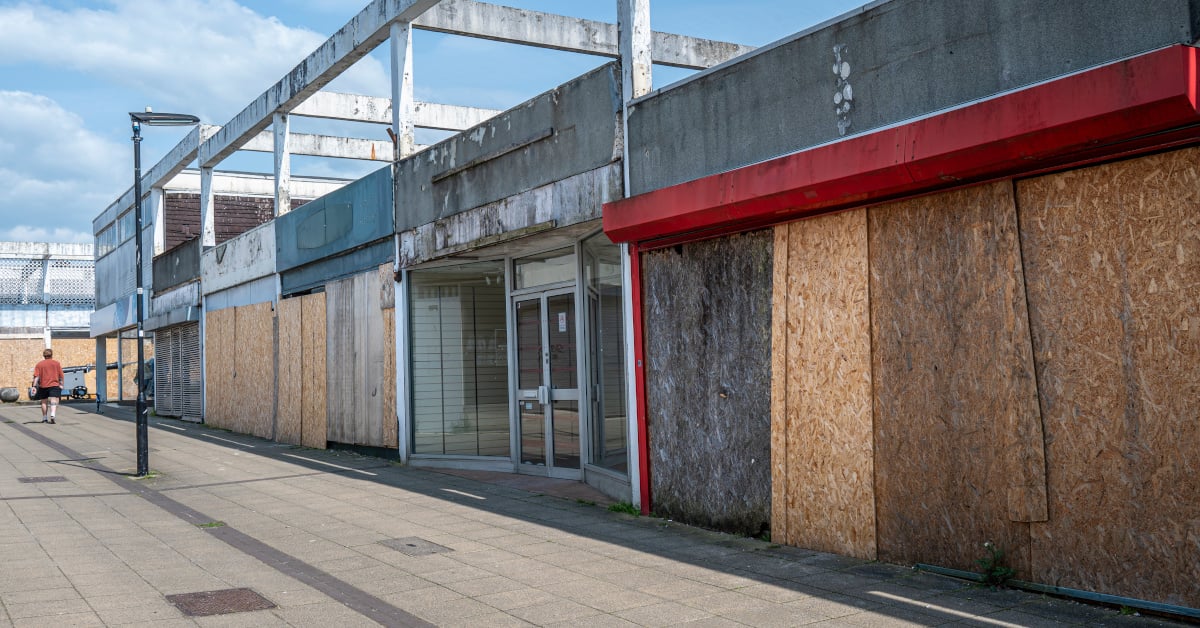
Closed and abandoned shops can change the landscape for a once-bustling high street.
What does this mean for the future of the high street?
The policy implication is not that every bank branch or supermarket should be prevented from closing. Consumer behaviour changes. Online banking is convenient for many customers and businesses cannot reasonably be expected to operate every physical location indefinitely.
The more important point is that the decision facing an individual business and the consequences for the surrounding area are not necessarily the same thing. A branch may be unprofitable from the bank's perspective while still generating footfall, surveillance and customers for nearby businesses. Those wider benefits do not generally appear in the bank's accounts. Equally, the costs of increased vacancy, declining neighbouring businesses, or greater social disorder are largely borne by other people.
In economic terms, these are local externalities.
That changes how we might want to think about urban planning and local development. The interesting question is not simply whether a particular bank branch can be persuaded to remain open forever – it probably cannot. More interesting are perhaps questions like what happens to a neighbourhood when an anchor disappears: how quickly the premises are reused, what replaces the lost footfall, and whether other forms of commercial or public activity can stop one closure becoming the beginning of a wider decline.
High streets, in other words, are not simply collections of independent shops. They are small local ecosystems in which businesses, customers, workers and public space interact.
Our results suggest that when an important part of that ecosystem disappears, some of the consequences may only become visible months or years later – and may extend well beyond the empty shopfront.
You might also like:
- read the research: Nils Braakmann and Diego Zambiasi, The death of the “High Street”? Main street closures, social disorder and urban change, Journal of Urban Economics, 154 (2026), 103884
- read the blogs:
- find out more about the work of Professor Nils Braakmann, Professor of Economics and Joint Head of Economics
- explore the work of Dr Diego Zambiasi, Lecturer in Economics
- find out how research from the Newcastle University Business School helps shape policies which aim to solve the pressing issues of today and tomorrow
