The UK’s continued reliance on fossil fuels for heating brings both growing financial pressures and environmental costs. Beneath our feet, however, lies a largely untapped resource with the potential to address both challenges.
Drawing on new research led by Newcastle University for Project InnerSpace's Future of Geothermal in the UK report, Dr Mark Ireland, Senior Lecturer in Energy Geoscience, explores how geothermal energy could play a central role in the future of the UK’s energy system.
Contents
The financial and environmental cost of heating
Rarely does a week pass during the winter months when we are not reminded of our reliance on heating in the UK. Whether that be ‘cold snaps’ that edge us to keep our heating on for longer, or coverage of rising domestic energy bills that put pressure on household finances, keeping warm comes at a cost.
That cost is also an environmental one. Currently, more than 80% of the UK’s heating demand is met by fossil fuels, principally natural gas. According to UK government statistics, domestic energy use in 2024 (excluding electricity and covering primarily heating and cooking) was 301TWh, representing 20% of the UK’s final energy consumption. This highlights an urgent need for us to transition from our reliance on fossil fuels for heating.
In 2024, the National Audit Office published a report on decarbonising home heating, concluding that ‘decarbonising home heating represents one of the biggest challenges to the government achieving net zero’.
While the Government’s recent Warm Homes Plan is an important step in bringing together existing schemes to accelerate improving energy efficiency for heating, the plan in part relies on the roll-out of heat networks. Which is where geothermal could, under the right conditions, play a central role.
A new roadmap for geothermal energy in the UK
Over the past six months, Newcastle University has supported Project InnerSpace, a leading independent non profit organisation dedicated to the global development of geothermal energy, as an author for a new report.
The Future of Geothermal in the UK is a groundbreaking multi-disciplinary and cross-collaborative study, supported by over 25 authors, peer reviewers, and collaborators, and was launched on the 5th February 2026. The report sets out a roadmap for building geothermal energy into a cornerstone of the nation’s energy system, while also reducing energy bills, creating thousands of skilled jobs. and reducing emissions.
What is geothermal energy?
Geothermal resources can be broadly grouped into shallow and deep geothermal.
While these categories are not formally defined in UK regulations, shallow geothermal generally refers to the low temperature heat (10 to 25°C) available in the shallow subsurface at depths of up to 500m. This resource is most commonly utilised using ground source heat pumps. This includes, for example, flooded coal mine workings being used as a geothermal heat source for heat networks.
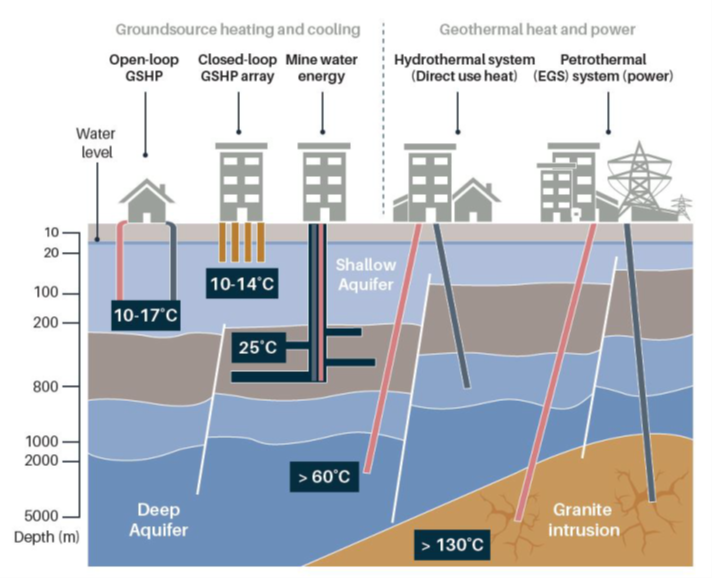
Image showing different types and ranges of geothermal systems. Source: British Geological Survey © UKRI. All rights reserved.
Deep geothermal is the heat available at depths greater than 500m, where temperatures increase with depth due to the geothermal gradient. Typical temperatures beneath the surface may range from around 40°C at 1km up to 140°C at 5km. At these temperatures, geothermal energy can be used directly for space and hot water heating without the need for a heat pump, and at the highest temperatures for electricity generation.
Looking deep beneath the surface of the UK
One of the first investigations into the geothermal potential in the UK was the Rookhope borehole drilled in 1961 in Weardale, County Durham (led by Sir Kingsley Dunham, from Durham University). It proved the presence of hot granite, which had been speculated, before the well was drilled.
Since then, at least in the case of deep geothermal, dedicated exploration for geothermal has been sporadic. In the 1970s and early 80s, linked to the oil crisis, research councils and the Department of Energy invested in exportation drilling. Efforts have since remained on the fringe of UK energy resources, although notable to us at Newcastle were the efforts led by the late Professor Paul Younger (together with Professor David Manning) to explore the opportunities beneath Newcastle.
However, despite the diverse portfolio of geothermal opportunities found in the UK’s varied geology, geothermal use across the UK remains limited compared with that in other countries.
The future of geothermal in the UK
Project InnerSpace’s new report highlights that the UK’s diverse geology offers a broad portfolio of geothermal resources that, if harnessed effectively, could make a significant contribution to the decarbonisation of heat, cooling, and electricity generation.
In our detailed examination of the opportunity for geothermal energy in the UK, the report highlights the urgent need for:
-
dedicated national strategy, supported by clear policy frameworks, public–private partnerships, and investment incentives
-
reprocessing and acquiring new geophysical data to reduce the uncertainty associated with resources, something that we have previously advocated for
-
standardised reporting and data-sharing frameworks to enable integration of public, academic, and commercial data sets, building on our previous recommendations
-
scaling up demonstration projects to de-risk investment and validate long-term performance
Turning opportunity into energy
While the scale of the opportunity is significant, the UK lacks the data, regulatory frameworks, and risk-sharing mechanisms required to move from resource estimates to bankable, ready to develop projects.
The ultimate barrier to the adoption of geothermal energy to the UK energy mix may not be the resources or technology, but finance.
Developing geothermal energy for both heat and electricity requires capital investment that is currently hard to secure. The report emphasises that there are pathways that could unlock investment, particularly clarifying how geothermal energy can significantly contribute to the UK energy mix.
To give one example of that contribution, modelling by Newcastle University indicated that even in a conservative scenario, a single deep geothermal development within the Bournemouth area could deliver 11.93 gigawatt hours per annum. This is broadly equivalent to meeting the annual space and water heating demand of around 1,000 typical UK homes [1], while avoiding approximately 2.4 kilotonnes of carbon dioxide equivalent (ktCO2e) per year.
Beyond heat, the report highlights the potential for geothermal energy to contribute to electricity generation.
With increasing temperatures at greater depth, high heat-producing granites offer opportunities for energy production, such as powering data centres in some locations. An example of this would be the current development in Cornwall of the United Downs Geothermal Project, which should see first production in early 2026, connecting an estimated 2Mw of electricity capacity to the grid.
Geothermal solutions across the UK
The potential contribution across the UK extends across a range of different applications and scales.
Shallow geothermal systems and aquifer thermal energy storage, which stores heat and cold in the subsurface as a way of heating and cooling buildings, could be readily deployed as solutions for urban decarbonisation, particularly where shallow aquifers are accessible and heating and cooling demand is high.
Deep sedimentary basins represent some of the largest medium-temperature heat resources in the UK, supporting district heating, industrial applications, and cooling for data centres.
High heat-producing granites offer potential for electricity generation (powering data centres in some locations) and other benefits such as critical mineral recovery. In addition, using mine water for geothermal provides a unique pathway to repurpose existing subsurface infrastructure for low-cost heating.
What is next?
Coordination will be key to unlocking the potential of geothermal energy in the UK.
One notable step is the appointment of Dr Alan Whitehead CBE as the Minister of State for the Department for Energy Security and Net Zero in November 2025, with specific responsibility for geothermal. When considered alongside the heat network zonation plans, which aim to unlock the coordination required to expand heat networks, perhaps the door is opening for geothermal. Other important initiatives include the establishment of the National Geothermal Centre in 2024, which provides coordination across the UK geothermal sector.
We are proud to have contributed to The Future of Geothermal in the UK, a report that provides a foundation for changing how geothermal energy is perceived across the public and private sectors. Through this work, we look ahead to building on Newcastle University’s rich legacy in geothermal energy research and innovation, working collaboratively with partners as the sector continues to develop.
You might also like
-
read the report: The Future of Geothermal in the UK
-
learn more about Dr Mark Ireland, Senior Lecturer in Energy Geoscience and Associate Director, Research and Innovation, in our School of Natural and Environmental Sciences
-
explore our Centre for Energy, which brings together expertise from across disciplines to unify efforts towards a new way of thinking about energy systems
- find out more about Project InnerSpace
Footnote:
[1] Based on the average gas consumption of 11,500 kilowatt hours per household per year.
