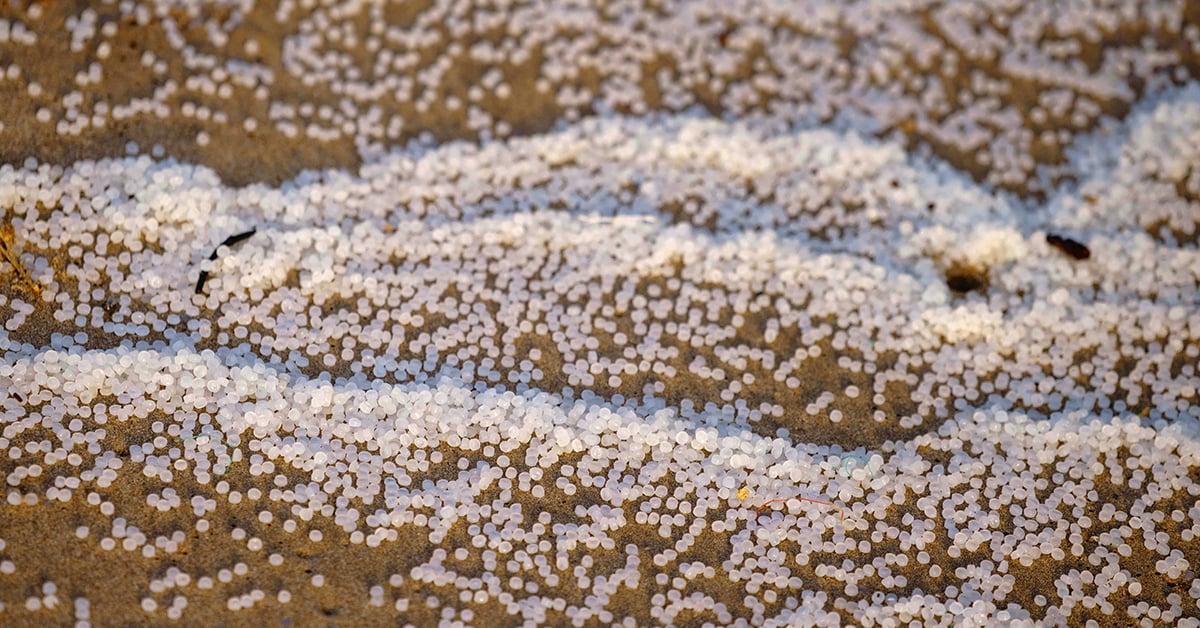
In July, a collision between two vessels at the Port of Tyne released an estimated 17.9 tonnes of tiny plastic pellets into the River Tyne. Six weeks later, new modelling by Newcastle University researchers suggests that around 2.2 tonnes of those pellets could still be trapped within the estuary.
While many of the pellets have already been carried out to sea, researchers say there is now a crucial window of opportunity to remove some of those that remain before higher river flows arrive later this autumn.
Contents:
- What is a nurdle?
- What happened to cause the spill?
- What impact do nurdles have on the environment?
- What have public efforts been so far to help?
- Understanding the flow of nurdles
- How many nurdles are in the sea?
- What needs to happen next?
- How can the public help?
What is a nurdle?
Nurdles are small plastic pellets, usually just a few millimetres in diameter, that are used as the raw material for making plastic products. They are sometimes described as the ‘building blocks of plastic manufacturing’.
Although tiny, nurdles can become a significant source of plastic pollution when they enter rivers and coastal environments. Their size makes them easy to transport by water and difficult to remove once dispersed.
An estimated 850 million nurdles were released into the River Tyne following the July incident, making arguably the most significant plastic pellet spill in a European estuary.
What happened to cause the spill?
On 19 July 2026, a vessel collision at the Port of Tyne resulted in a container of plastic pellets entering the river. Newcastle University researchers estimate that around 17.9 tonnes of nurdles were released into the tidal Tyne.
From the moment they entered the water, the pellets began moving with the tides, river currents, wind and waves. While many were quickly transported downstream and out to sea, others became stranded on shorelines or deposited in parts of the estuary.
What impact do nurdles have on the environment?
Nurdles do not biodegrade, and can persist in the environment for many years.
They can accumulate along riverbanks, saltmarshes, mudflats and beaches, where they may be ingested by wildlife or become increasingly difficult to recover. Over time, they can also break down into smaller pieces, adding to the wider problem of microplastic pollution.
One of the challenges for environmental responders is that nurdles are impacted by a range of environmental processes. Some remain floating at the surface, their movement driven by current and winds; while others can become trapped in sediments, vegetation, or sheltered areas of the estuary.
Understanding where nurdles are likely to accumulate is therefore essential for planning effective clean-up operations.
What have public efforts been so far to help?
Since the spill, volunteers, community groups, local organisations and environmental agencies have worked to recover pellets from affected areas.
Public reports have also been crucial in building a picture of where nurdles have appeared along the coastline. Sightings submitted by local residents have helped researchers compare real-world observations with the patterns predicted by computer models.
The response has also brought together volunteering and research. A team from the Dove Marine Laboratory launched Columba to support the clean-up effort, working alongside the Port of Tyne, local industry, and other interested parties.[CH1]
These efforts have already removed a significant quantity of material from the environment, but researchers believe a substantial amount remains within the estuary.
Understanding the flow of nurdles
A team of Newcastle University researchers has developed a detailed computer model of the River Tyne estuary and the neighbouring North Sea to understand how the nurdles have moved since the spill. The modelling has informed advice provided to the Scientific and Technical Advice Cell (STAC), which brings together specialist expertise to assess the spill’s ongoing impacts and advise the organisations coordinating recovery and monitoring efforts.
The model incorporates information about river flows, wind and waves, while reproducing the timing and size of measured tides, both at the coast at North Shields and upstream at Gateshead. Researchers then released 10,000 virtual particles into the model at the location and time of the incident to simulate how the nurdles were likely to travel.
The results suggest that movement out of the estuary began almost immediately. By 3 August, around 62% of the spilled pellets had left the river. However, by the end of August, approximately 16% were still estimated to be within the estuary.
'Because river flows have been so low since July, pellets that moved up the estuary and were deposited have had little to move them on. When elevated river flows arrive, some of that material is likely to be flushed downstream, so now is the time to consider where it could be intercepted.' — Dr Matt Perks, Senior Lecturer in Physical Geography
Taking account of pellets already removed during clean-up operations, the team estimates that around 2.2 tonnes remained in the Tyne six weeks after the spill.
'Over the coming months our fieldwork will measure directly how pellets move with the tide, which will let us test and improve these predictions.' — Dr Matt Perks
The modelling forms part of Newcastle University's Against the Flow project, which will begin fieldwork this autumn. Researchers will use drone surveys, net sampling, sediment sampling and laboratory analysis to better understand how nurdles move through the estuary.
How many nurdles are in the sea?
The researchers are most confident about what happened within the River Tyne itself.
Their modelling suggests that while most pellets were transported out to sea within a few weeks, a significant proportion remained trapped within the estuary. Areas where pellets have settled may become important targets for future recovery efforts.
The picture becomes much less certain once pellets reach the North Sea.
Researchers found that offshore movement depended heavily on changing currents and wind conditions. One plausible scenario showed pellets moving northwards along the coast during early August before gradually shifting southwards over subsequent weeks. This broad pattern appears consistent with recovery reports from coastal locations.
However, the team stress that these offshore maps should be viewed as potential pathways rather than definitive records of where individual pellets travelled.
Even after allowing for everything the clean-up teams recovered, more than two tonnes of pellets were still in the river six weeks after the spill. Where the rest went at sea is much less certain, and we've been careful to present those maps as possibilities rather than predictions." — Dr Seb Pitman, Senior Lecturer in Physical Geography
A computer model simulating likely nurdle distribution in the 10 weeks following the spill.
What needs to happen next?
The team's key recommendation is that action should be considered before autumn and winter bring higher river flows.
River levels have remained relatively low since the spill, meaning many pellets deposited within the estuary have stayed largely undisturbed. As wetter weather arrives, stronger flows could remobilise some of those pellets and carry them downstream and out to sea.
Researchers therefore recommend exploring opportunities to intercept, trap or recover nurdles at locations where this can be carried out safely and effectively.
The coming weeks may provide an important opportunity to remove material before changing river conditions make recovery more difficult.
How can the public help?
Public observations remain an important part of the research effort.
The Newcastle University team is asking people to report where and when they have seen nurdles, including locations where searches found none. Negative sightings are just as valuable because they help researchers understand where pellets are not accumulating.
As fieldwork begins and new data becomes available, those public observations will help researchers build the most accurate picture yet of how millions of plastic pellets have moved through the Tyne and beyond.
You might also like…
- read the press release: More than two tonnes of spilled nurdles may still be in the River Tyne
- more information about the project is available on the Tyne Nurdles website
- help with mapping the spill by reporting where and when nurdles have been spotted
- find out more about project lead, Dr Matt Perks, Senior Lecturer in Physical Geography
- read more about Dr Seb Pitman, Senior Lecturer in Physical Geography
- interested in getting involved? Find out more about a PhD studentship opportunity to investigate the dispersal, retention and remobilisation of nurdles
