Laboratories are essential to research, but they can also have a significant environmental impact, from the consumption of energy and water to single-use waste generation. So, what are our researchers doing to reduce that impact, and how can other labs follow their example?
Across Newcastle University, researchers, technicians and support staff are finding practical ways to reduce the environmental impact of laboratories while maintaining the highest standards of research.
For our wet laboratories, sustainability accreditations are used to help aide and guide this.
Contents:
- What is LEAF?
- Making sustainability part of everyday laboratory life
- From individual efforts to a shared responsibility
- Formalising good practice
- Sustainability as a first thought
- The power of sustainability
What is LEAF?
LEAF (laboratory efficiency assessment framework) is run by University College London (UCL) and is a platform that enables wet labs to improve sustainability and efficiency.
LEAF provides a structured way for wet laboratories to review their practices, identify opportunities for improvement and recognise the work already taking place. Laboratories work towards Bronze, Silver and Gold accreditation, with the aim of reaching and retaining Gold.
For some labs, the process has meant formalising sustainable practices that were already well established. For others, it has provided the structure to turn individual efforts into a shared approach.
Since the University began running LEAF in its labs in January 2022, participation has grown to ninety-eight laboratories, and this number continues to rise.
Making sustainability part of everyday laboratory life
For the Eukaryotic Super Lab, the starting point was familiar to many research-intensive laboratories: people were already trying to recycle and reduce waste, but there was no coordinated approach.
The shared ‘Superlab’ environment brings together research groups working across cell division, parasites, reproductive biology, and advanced microscopy. With a busy research environment generating significant waste and consuming substantial amounts of energy, the team wanted to find practical ways to make sustainable working part of everyday research.
'LEAF gave us a practical framework to bring those conversations together. Rather than treating sustainability as an occasional initiative, it encouraged us to look at our everyday habits and ask how they could be improved, to ultimately turn good intentions into consistent actions.' – Eukaryotic team member
One of the biggest changes was the creation of a laboratory handbook, alongside a General Induction Checklist so that new members receive the same information and expectations from day one.
Achieving Bronze also involved a series of practical changes. A traffic-light system was introduced on equipment to make clear what should be switched off and when. Cold storage was reviewed, with regular maintenance and defrosting schedules, while the team looked again at waste segregation to make sure energy-intensive clinical and autoclave waste streams were reserved for genuinely contaminated materials.
Sustainability is now a standing item at lab meetings, with an annual review of progress.
'Perhaps the biggest cultural change is that sustainability is no longer an afterthought. It's now something that is introduced on a researcher's first day, reinforced through our inductions, visible throughout the lab, and revisited regularly in meetings and discussions.' – Eukaryotic team member
The shared approach has also encouraged collaboration between research groups, including greater sharing of equipment, resources and expertise. The lab now has a shared chemical system and has made a concerted effort to use up overstocked products communally. Shared knowledge resources, including communal protocol repositories on Teams, have also encouraged more interaction between groups and opportunities for troubleshooting.

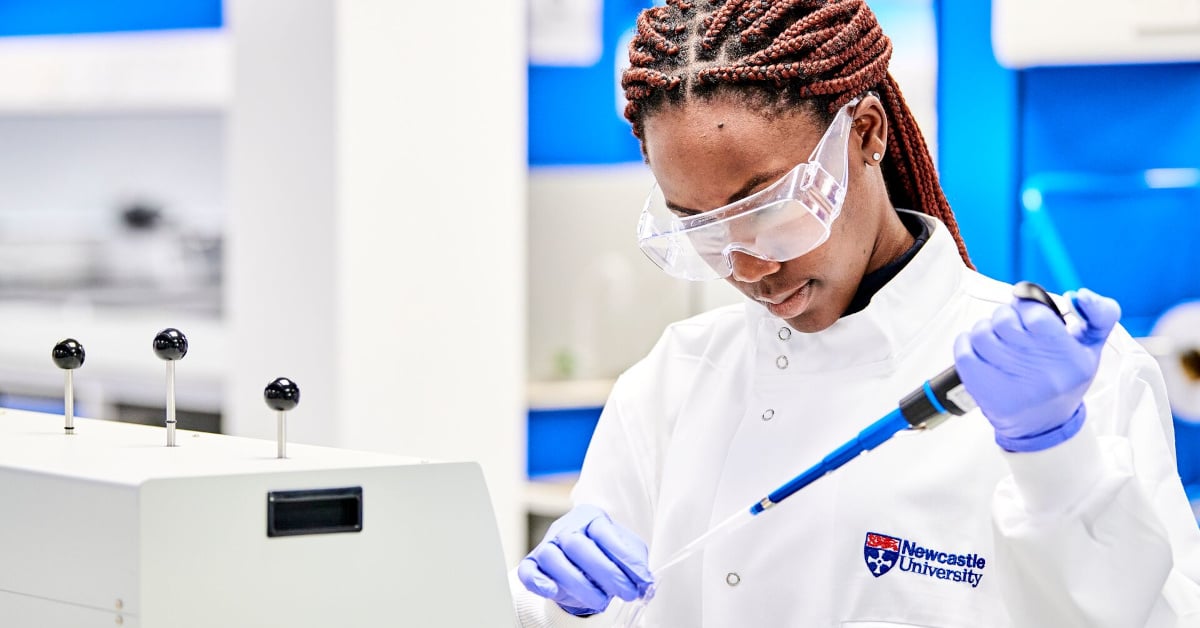
Newcastle University labs maintain the highest standards of research while remaining sustainable. Image credit: John Donoghue
From individual efforts to a shared responsibility
A sense of collective responsibility is also at the heart of the LEAF journey in the shared laboratory spaces at Newcastle’s Campus for Ageing and Vitality (CAV).
Like in the Eukaryotic Super Lab, sustainable practices were already taking place across the campus, but they were informal, inconsistent, and not always documented.
'LEAF provided a structured approach to review our practices, identify opportunities for improvement, and capture activities that were already making a positive environmental impact.' – Claire Kolenda, CAV team member
Working across a shared laboratory environment meant looking beyond individual research groups and considering sustainability across the whole campus. The process led to clearer signage, formalised procedures, expanded recycling and reuse schemes, reviews of equipment management, and greater awareness of sustainable research practices through inductions and meetings.
LEAF has also created opportunities for researchers, technicians and support staff to share equipment, freezer space, consumables, good practice, and expertise. Discussions around sustainability take place through local meetings and campus-wide communications, while links with other departments and the University Sustainability Team have helped colleagues share experience and resources.
For researchers, this can mean considering resource use when planning experiments, reducing single-use plastics where practical, improving waste segregation, making greater use of shared resources and reviewing freezer and energy use.
Formalising good practice
In Newcastle’s Centre for Cancer's medicinal chemistry laboratories, the LEAF journey began in 2023.
The team quickly found that many of its existing practices already met the Bronze and even Silver criteria. There were established systems for waste segregation and recycling, while an electronic inventory system was being used to track chemical purchases and stock levels.
The improvements needed to achieve Gold were relatively small, including additional signage to remind lab users what could be recycled and how waste should be disposed of.
'Our laboratories already maintained high standards of organisation, sustainability and good practice, and the LEAF framework provided an excellent opportunity to formalise these practices, identify small areas for improvement, and embed a culture of continuous environmental responsibility.' – Jennyfer Goujon-Ricci, Centre for Cancer team member
Another benefit of running LEAF in the lab has been making sustainability more visible. The framework has helped raise awareness among new and existing lab members, helping to ensure environmentally responsible practices are consistently followed rather than simply assumed.
Sustainability as a first thought
For the Eukaryotic Super Lab, the next stage is to consider sustainability earlier in the research process.
The team is beginning to think about how resource consumption can be reduced at the project design stage, including where changes could also reduce costs without compromising scientific quality.
For CAV, the focus is similarly on continuous improvement. Sustainability is expected to become increasingly integrated into project planning, purchasing decisions, equipment management and laboratory operations, with new staff and students joining an environment where sustainable working practices are already established.
And for the Centre for Cancer, renewing LEAF accreditation provides an ongoing benchmark against which practices can be assessed and improved.
Perhaps the most important long-term impact, however, will be on the people working in the labs. PhD students, postdoctoral researchers, and early-career scientists are being exposed to these practices from the beginning of their careers. The hope is that sustainability becomes second nature for them, so that whether they go on to lead their own research groups, work in industry, or move into other sectors, they carry those habits and expectations with them.
The power of sustainability
Whether through LEAF accreditation, changes to everyday laboratory practice or future-proofing a sustainable way of thinking, these examples share a common thread. Sustainability becomes more powerful when it moves from individual good intentions into shared action.
For Newcastle's laboratories, LEAF provides a framework for that process to continue — helping colleagues review what they do, share what works and look for practical ways to make research more sustainable while maintaining the standards of safety and scientific quality that underpin it.
You might also like:
- learn more about LEAF (laboratory efficiency assessment framework)
- discover the spectrum of work carried out at Newcastle’s Campus for Ageing and Vitality (CAV)
- find out more about what happens at Newcastle’s Centre for Cancer

Header image credit: John Donoghue