-2.jpg)
Why are tuna shaped like torpedoes, while reef fish are often tall and flat? Why do some deep-sea fish have enormous eyes, while others have mouths that point sharply upwards or downwards? Dr Isabel Smallegange and Victoria Dixon tell us more.
Contents:
- Reading the story written in a fish’s body shape
- Lateral size morphology links to generation turnover, but not universally
- Why this matters for ocean science
- The shape of survival
The extraordinary diversity of fish body shapes is not random. Over millions of years, fish have evolved bodies that are adapted to moving, feeding, avoiding predators and surviving in very different ocean environments.
A streamlined tuna is built for speed and long-distance swimming in the open ocean. Deep-bodied reef fish are adapted for manoeuvring through structurally complex habitats. Deep-sea species often evolve larger eyes to cope with extremely low light conditions, helping them detect prey, predators and even bioluminescent signals in the darkness.
In many ways, a fish’s body is a record of the ecological challenges it has evolved to overcome. But could body shape also reveal broader patterns in how species grow, reproduce and persist in different environments?
Reading the story written in a fish’s body shape
In our latest research, we explored whether fish morphology could help reveal broader ecological and life-history strategies across species.
Climate change, habitat degradation, pollution and overfishing are placing increasing pressure on marine ecosystems worldwide. Yet species do not all respond in the same way. Some populations appear to recover relatively quickly after disturbance, while others are much slower to rebound.
Understanding these differences usually requires detailed demographic data collected over many years. Scientists need to estimate how quickly species grow, when they reproduce, how many offspring they produce, and how long individuals survive. But for many fish species, especially deep-sea or poorly studied species, these data simply do not exist.
We therefore asked a different question: could combinations of body traits help reveal broader ecological and life-history patterns across fish species?
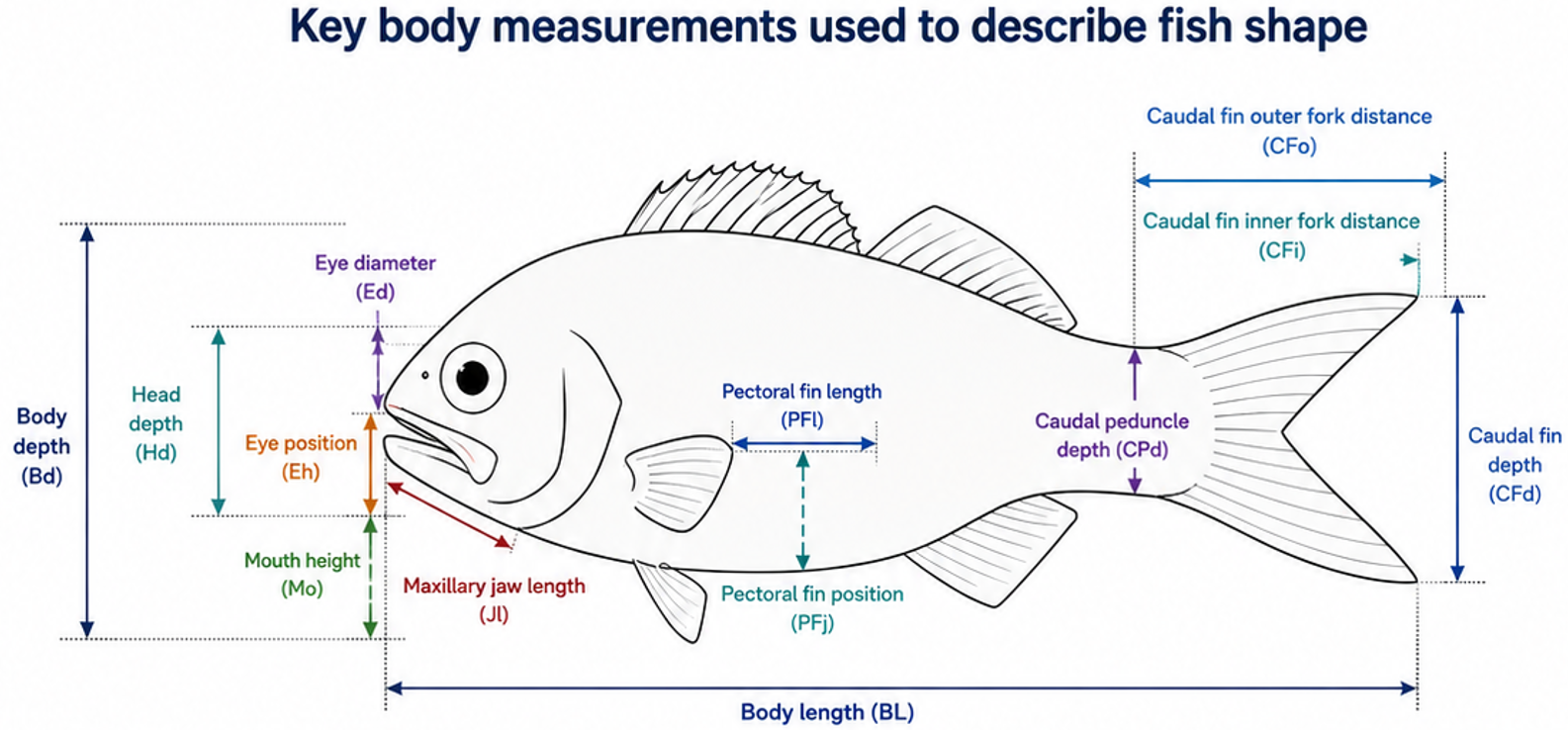
Figure 1. Morphometric measurements used to quantify fish body shape. Diagram illustrating the key linear measurements used to characterise lateral body morphology in fishes, including body depth, caudal peduncle dimensions, head proportions and fin placement. These measurements were used to derive comparative metrics of body elongation and overall body form across species. After Table 2 in Dixon & Smallegange (2025).
To investigate this, we analysed photographs and demographic models for nearly 290 marine and freshwater fish species (Figure 1). Rather than looking at single traits in isolation, we examined composite axes of morphology that combined characteristics such as body elongation, relative eye size, mouth position and fin placement.
Lateral size morphology links to generation turnover, but not universally
We studied fish of all different shapes and found that body shape, eye size and mouth position correlated with generation turnover (or how quickly populations replace themselves over time). We named this group of traits 'lateral size morphology', which captures fish shapes from elongated with relatively large eyes and upward-facing mouths to rounder-bodied with smaller eyes and lower mouth positions (Figure 2).
Crucially, the link between lateral size morphology and generation turnover was not universal.
We found that lateral size morphology had different ecological implications depending on where species lived in the water column and which evolutionary lineage they belonged to (Figure 2). This means there is no single ‘successful’ fish body shape. Instead, evolution has repeatedly resulted in different combinations of traits through which species have adapted to survive in very different marine environments.
These findings matter because many species are increasingly exposed to pressures such as warming oceans, habitat disturbance and fishing activity, while often remaining poorly studied. Species with body shapes linked to slower generation turnover may therefore respond more slowly to environmental change and population decline.

Figure 2. Ecological patterns associated with lateral body morphology. Conceptual summary of broad ecological trends associated with fish body shape. Elongated body forms show substantially higher generation turnover rates in pelagic, reef and seafloor environments relative to deep-water systems, whereas deeper-bodied forms exhibit less pronounced environmental differences in turnover.
Why this matters for ocean science
Collecting detailed demographic data for every fish species on Earth is unrealistic. Many marine species remain data-poor, particularly in deep-sea ecosystems where sampling is difficult and expensive.
Our results suggest that body shape may help scientists identify broader ecological and life-history patterns even in species where long-term demographic data are lacking. Morphology can thus offer a potential shortcut.
Unlike long-term ecological studies, body shape can often be measured relatively quickly from photographs or museum collections. If these traits consistently reflect broader ecological and life-history strategies, they could help scientists rapidly characterise poorly studied species and better understand patterns of vulnerability across marine ecosystems.
The shape of survival
The shape of a fish is more than just anatomy. It is a record of evolution, ecology and survival written onto the body itself.
And in a rapidly changing ocean, learning to read those shapes may help us better understand how species have adapted to life in different marine environments, and which species may be most sensitive to future environmental change.
You might also like
- read the preprint: Dixon V, Smallegange IM. 2025. From form to function: Morphology as a proxy for life history and population performance in fish. https://doi.org/10.1101/2025.11.12.688009
- explore for yourself how the life histories of fish of all shapes and many other coldblooded species vary with feeding levels using an interactive app, with instructions here
- learn more about Dr Isabel Smallegange, Senior Lecturer in Population Biology at Newcastle University, and explore her blog
- read more about how big data can predict species responses to climate change in Dr Isabel Smallegange’s earlier blog
- explore our diverse and wide-ranging ecology and conservation research, computational biology research, and our School of Natural and Environmental Sciences
