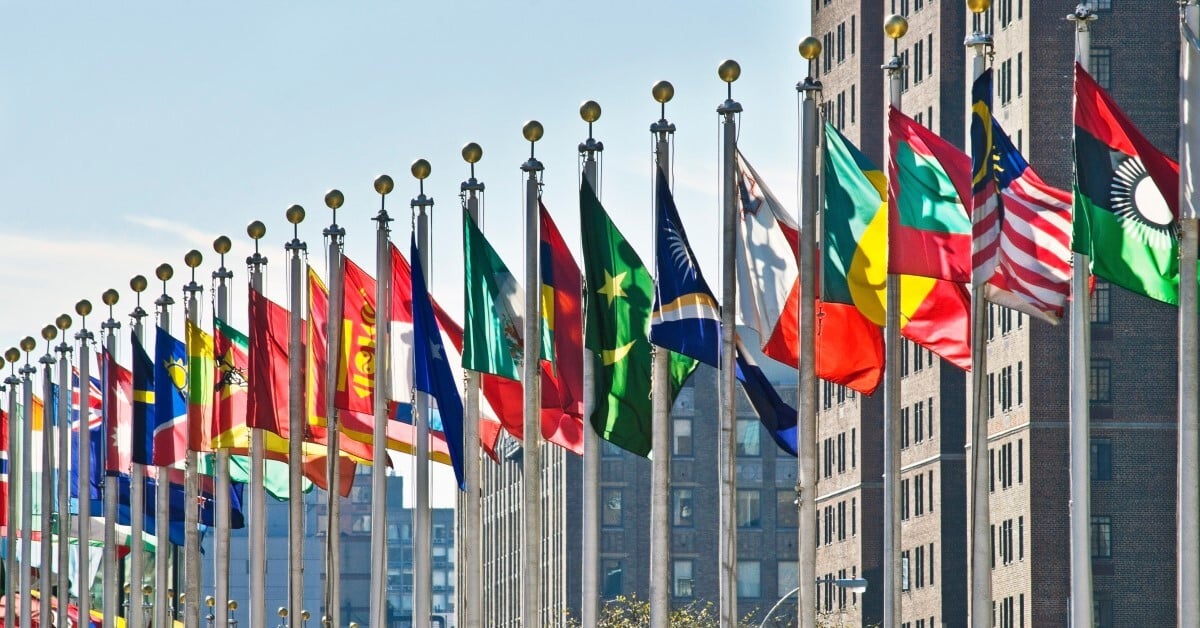
Every year on 12 December, the United Nations marks the International Day of Neutrality – a reminder that stepping back from conflict can sometimes help prevent it.
But in an age of choice and the interconnectedness between trade and foreign policy, can any nation truly be neutral in 2025?
In today’s fast-moving world, events in one region can quickly cause rifts and shifts across the globe. How is it possible, then, for any country to truly stay neutral?
Here, Senior Lecturer in Contemporary British History Dr Martin Farr explores how the idea of neutrality has shifted over time and shares his view on whether the UN’s International Day of Neutrality, and indeed the UN itself, still holds political influence in our interdependent global society.
Contents:
- Neutrality in the rifts and shifts of 2025
- The history of neutrality
- Neutrality in a new geopolitical reality
- The new world order
- Neutrality vs national interest
- So what next?
Neutrality in the rifts and shifts of 2025
In a world where global events reverberate quickly and often unpredictably, questions of conflict, cooperation and neutrality are becoming ever more pressing. From shifting alliances to new geopolitical pressures, the idea of ‘standing apart’ from international disputes has grown both more complex and more contested.
The UN’s International Day of Neutrality offers a timely moment to reflect on what neutrality means today and whether it does (or should) still matter. For universities, these conversations are not abstract. They shape how we prepare our communities to engage thoughtfully with world events, how we support informed debate, and how we contribute to civic life in turbulent times.
But what do we mean by neutrality?
The history of neutrality
The UN defines neutrality as ‘the legal status arising from the abstention of a state from all participation in a war between other states, the maintenance of an attitude of impartiality toward the belligerents, and the recognition by the belligerents of this abstention and impartiality’. It is intrinsic to the institution. The UN Charter, signed in San Francisco in June 1945, committed members to ‘the suppression of acts of aggression or other breaches of the peace, and to bring about by peaceful means’.
The most obvious example of state neutrality in our history comes from Sweden, which has been neutral since the end of the war with Finland in 1809. Finland itself had its own form of neutrality in the past – known as ‘Finlandization’ – shorter-lived than Sweden and shaped as much by the pressure of their border with Russia as by choice. Russia last invaded Finland in 1940, with war only ending when Finland ceded 11% of its territory.
Is it a coincidence that these neutral nations rank so high on the world Democracy Index (Sweden is third and Finland sixth)?
This historic neutrality, however, ended in 2022 with the Russian invasion of Ukraine, prompting both Sweden and Finland to join NATO.
Their Nordic neighbour, Norway, a country who has also historically held neutrality as a cornerstone of foreign policy, has recently deepened defence cooperation with Britain with the Atlantic Bastion programme and signing of the Lunna House Agreement, committing that their navies will operate an interchangeable force of anti-submarine warfare frigates to combat Russian submarines in the GIUK Gap: the ocean between Greenland, Iceland and the UK. Such schemes are Moscow’s pretexts for military operations, special or otherwise.
Neutrality in a new geopolitical reality
The world appears to be undergoing the disintegration, through pressures internal as well as external, of its self-styled ‘rules-based order’. At the UN General Assembly in September – the annual temporary uniting of the leaders of those nations – the fissures were clear. Indeed, the head of state of the host nation denounced the very institution.
And just this month, the second Trump administration released their National Security Strategy, welcomed by Russia: "the adjustments we're seeing, I would say, are largely consistent with our vision" said government spokesman Dmitry Peskov. The strategy also, incidentally, does not mention the United Nations at all.
By eschewing neutrality, Sweden and Finland exited a select club of states and (often more significant) statelets – for example Andorra, Vatican City, Panama – who, in cricketing parlance, tend not to trouble the scorers.
But even here, ‘neutral’ is doing a lot of work.
They may be free from the embrace of military alliances, but the reach of China’s Belt and Road Initiative makes neutrality more chimeric than ever. Indebtedness brings its own forms of insecurity. Just as the nineteenth century was marked by both formal and informal empires, the twenty-first has only the latter, and with particular force.
The history of UN peace-making is necessarily patchy (a vital, empathic qualifier). October brought the suspension – if not resolution – of the most protracted, violent, and globally divisive Middle East war in history. The Israel-Hamas war’s reach was much greater than the ordnance each side threw at the other. Hard though that was, even in the bipolar world of UN's first forty years, it is more challenging still in today's multipolar world, where a rules-based system has been supplanted by one based on power (critics of the West would argue it always was). That the global share of Gross Domestic Product (GDP) marked by the G7 has shrunk from 70 per cent in the 1980s to 28 per cent today tells only half of the story.
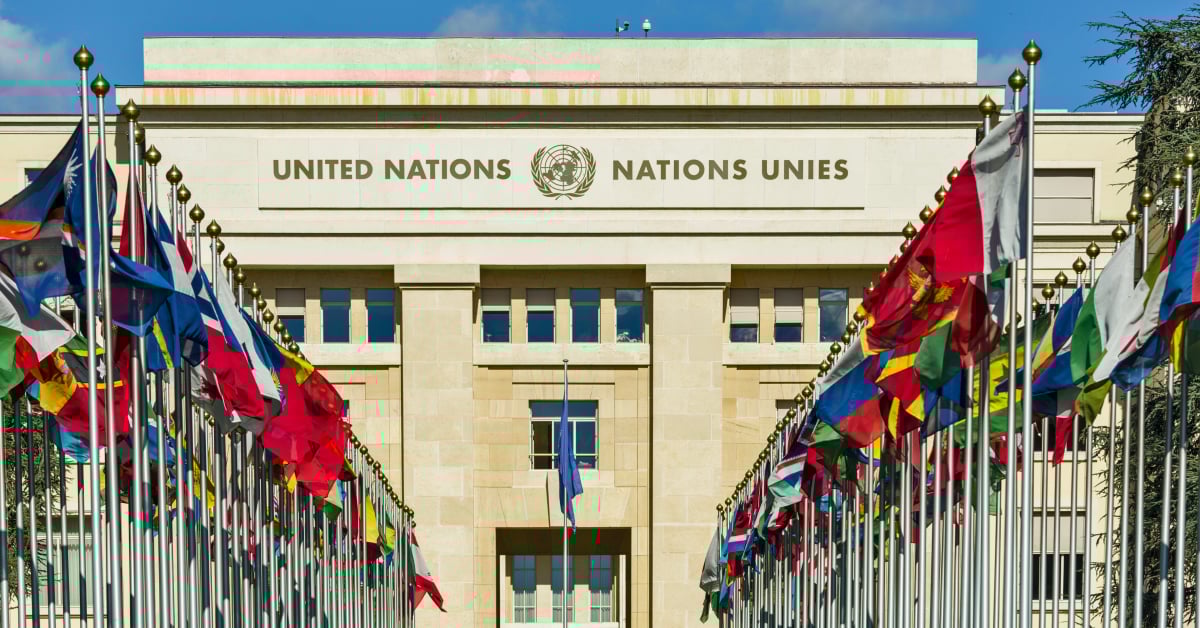
The United Nations building in Geneva.
The new world order
Seven per cent of the world’s population live in a ‘full democracy’, defined as nations where civil liberties and fundamental political freedoms are not only respected but also reinforced by a political culture conducive to the thriving of democratic principles.
This seven per cent statistic is half what it was ten years ago.
Full democracies have become partial, weakened as incumbents resist tides of anti-incumbency by curbing the checks and balances inherent to them. Elections and a free press are steadily less free. If it follows that democracies neither go to war with each other nor suffer famine, there may be unnerving consequences.
The UK is particularly exposed. More than a middle power – around sixth globally in GDP and defence spending, a permanent member of the UN Security Council, a member of the G7, NATO, and more – it has been weakened by Brexit and the convulsions of the financial crash, Covid, and the consequences of war in Europe. Five parties in England, and six in Scotland and Wales, are polling comparably in a situation without precedent or parallel. Multi-party politics in a First-Past-the-Post electoral system guarantees uncertainty.
To add to this, Britain has been assailed by Chinese espionage while simultaneously being pressured to allow China to open the largest embassy in Europe: commercial and intelligence concerns melded in the hesitation.
New powerful alliances of non-Western states, notably the BRICS (Brazil, Russia, India, China, South Africa) and CRINKS (China, Russia, Iran, North Korea), are reshaping global influence. The latter meeting in Beijing in September 2025 and loyally contributing to war against Ukraine. The Non-Aligned Movement – the oldest and largest grouping of nations after the UN itself – no longer carries anything like the same purpose. By attending the 2025 BRICs meeting rather than the Commonwealth summit, India’s Prime Minister Narendra Modi prioritised a gang of autocracies over an association of democracies committed to human rights. And with India’s national interests in mind, he was right to do so.
Neutrality vs national interest
Neutrality works against interests, unless, of course, those interests are served by it, which is rather a niche area.
Britain, with a global past, has foregrounded interests - the acquisition and maintenance of a global presence. When that was no longer possible, the goal was merely to retain influence. Ireland’s neutrality is understandable in light of its bruising history with Britain, and has gone predominantly unnoticed, until now. Ireland has a population comparable to Finland and a GDP similar to Sweden, yet has neither military radar nor sonar, a centralised intelligence agency, or combat aircraft. It spends just 0.24 per cent of GDP on defence, compared to a European average of 1.74 per cent.
Fluid, uncertain, neutrality feels as fanciful as consensus. The politics of migration - and its economic and cultural ramifications - dominate Western public realms. Funding for soft power has been diverted to hard power as domestic support for foreign aid withers in light of the cost of living. Misogyny is increasingly a mainstream ideology, abetted by ever-more vocal natalist movements, animated by immigration/displacement with blood-and-soil-nationalism, as well as disinformation and the barely-understood potentialities of AI. Nationalism and anti-internationalism, ironically, constitute their own internationalism. If one can appear somewhat alarmist – even hysterical – that is in part because it’s easy.
One wills optimism. But the self-preservation of self-interest feels the extent of it. It may yet save Taiwan from the depredations of a global power with too much to lose. The likely largest party in the House of Commons is also the most radical ever to be on the threshold of power, something that may very well prevent its ascent. But whether Britain wants or needs Reform, there is a good chance that it will receive it; such is the clarion in the National Security Strategy that Europe must 'regain its civilisational self-confidence'.
So what next?
The world is facing significant geopolitical tension, democratic backsliding, and competing visions of global order, not to mention the simultaneous transparency and trickery of digital communications. Neutrality may be harder now than ever. But the need for thoughtful and informed engagement with the concept has never been greater.
This reinforces the importance of education as a platform for, and participant in, civic engagement, such as Newcastle University’s NCL in Action programme, for which I recently delivered the keynote address. The wish to be positive for a public audience chafed against a serious analysis of what is taking place; the most challenging international situation since the collapse of communism at the end of the last century.
Our attempts as educators to shape events are aspirational, one point of connection with diplomacy. More than any other area of public policy, foreign policy is reactive, and even for great powers, preventive diplomacy is an ideal.
UN awareness days like the International Day of Neutrality ought to be better known. They are laudable, as is their sponsor, 80 this year. The UN is, in one sense, all we have. But as every beleaguered Secretary-General – those who weren’t assassinated – would attest, what is necessary is rarely sufficient.
There has never been a more urgent need for neutrality. But what will prevent war is deterrence. As borders cease to bound, ploughshares are turned back into swords, guns preferred to butter, and the historian professes that, contrary to appearances, the future isn’t their period.
Peace-making has seldom seemed so attractive.
You might also like
- discover more about Dr Martin Farr, Senior Lecturer in Contemporary British History
- explore NCL in Action 2025: Rifts and Shifts, including upcoming events, career development and alumni changemakers
- find out more about the United Nations’ International Day of Neutrality on 12th December
- explore the work of Dr Martin Farr, Senior Lecturer in Contemporary British History in the School of History, Classics, and Archaeology at Newcastle University
