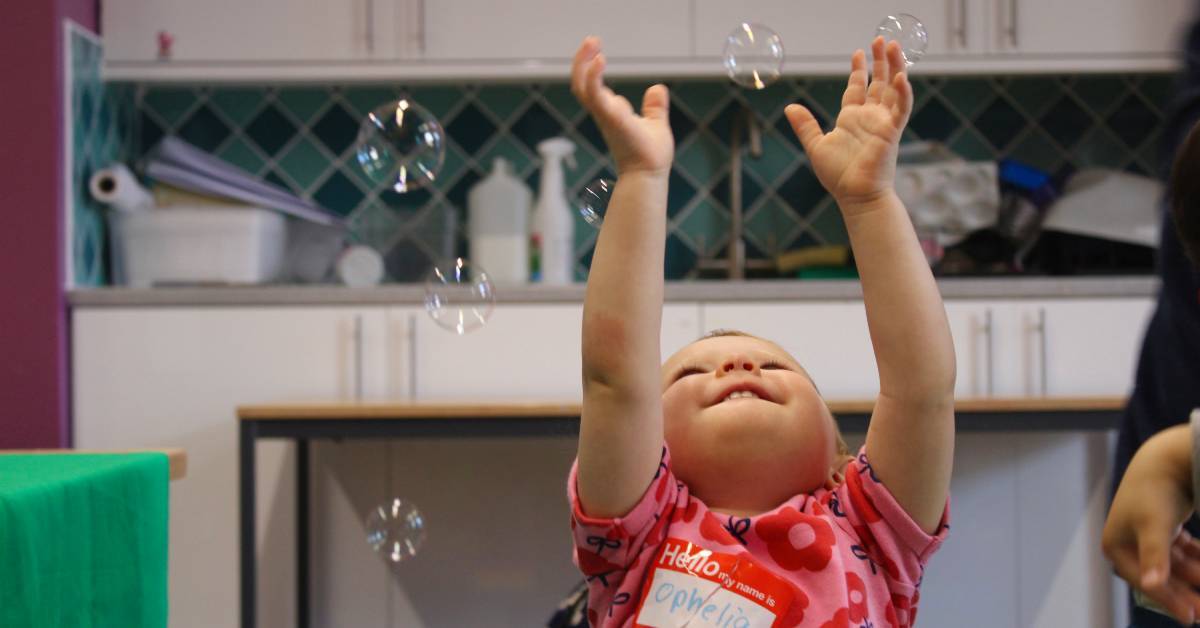
How is it that humans learn to talk, and in what ways do we communicate before learning language? Emeritus Professor Paul Seedhouse writes about the essential developments that occur before we speak at all.
Contents:
- When we think about ‘talking’, what do we mean?
- What is the interaction engine?
- What are the three main mechanisms of the interaction engine?
- How do babies communicate before language?
- How important is socialisation in child language acquisition?
- How does neurodiversity relate to the interaction engine?
- Does the interaction engine differ around the world?
- How does the interaction engine feature in multicultural or multilanguage homes?
- When did the interaction engine begin developing in humans?
- Why is this not being studied more widely?
- What can families do to help babies develop the skills they need?
When we think about ‘talking’, what do we mean?
Language is only one of the two separate complex systems we use in combination to produce the third, which we call ‘talk’.
The other system is the ‘interaction engine’, so-named by Stephen Levinson, expert in language and cognition at the Max Plank Institute for Psycholinguistics. This is the universal, foundational system which we all learn as infants before we learn languages.
The interaction engine has always been the ‘Cinderella sibling’, the hidden system supporting language use which helps make talk comprehensible.
Language is primarily an information processing system, whereas the interaction engine is primarily a system for managing social networks and mutual understanding. Talk emerges from the interplay of those two systems.
In contrast to the diverse languages which have often separated us, the interaction engine brings us all together in a communal human experience. It's what enables us to communicate with others, whenever language is a problem.
What is the interaction engine?
The interaction engine is a universal system which helps all humans to understand each other whenever we are talking, whichever language or languages we are using.
We cannot learn a language until we have learned the interaction engine. It introduces how to bond with others, become members of a family and community, and understand each other as a prelude to doing this again with language. Nothing in language itself specifies how we do these things, so we first have to learn the interaction engine.
Once this is done, they can learn any and every natural language.
We know from cases of children who had spent their childhood alone in captivity, that spoken interaction is a pre-requisite for language.After being released, these children found language very difficult to learn as they had missed out on the phase when the social basis for language (the interaction engine) is acquired.
The first year of life has a profound impact on what follows. Just in terms of learning, three weeks after birth, the brain volume is about 35% of adult volume. By the end of the first year, this has doubled. There’s also clear evidence of a link between parental sensitivity at three months and infants’ productive language scores from 18-30 months later.
Evidence of language comprehension is not found until around six months, but a lot happens in those first months. This development is the foundation for what follows: understanding the world and developing the mechanisms for productive interaction.

A young visitor with face paint explores the activity table at Babyzone Grimsby. Photo credit: Babyzone.
What are the three main mechanisms of the interaction engine?
Its three main mechanisms are sequence organisation, turn-taking, and repair.
In adults, sequence organisation and turn-taking are mechanisms we use for displaying and checking mutual understanding. Repair is the mechanism we use for fixing problems in understanding.
The interaction engine provides the infrastructure for speakers to mirror their communicative intentions to each other. This might be during interactions, exchanging information, performing social actions, or resolving problems. It is a multimodal system, meaning we can communicate non-verbally, such as agreeing by nodding our head.
The interaction engine means that we can change languages in the middle of our turn (code-switching) without changing the meaning of the turn. When people do not share any language, we can replace it with mime and gesture. Travellers have managed this for millennia.
Sometimes language is lost in adults, for example in cases of aphasia. But as long as the interaction engine is intact, communication can continue. Infants can communicate with others verbally, non-verbally, and multimodally before they learn to use language. The work of Emeritus Professor Charles Goodwin shows how someone with a vocabulary of only three words can still interact successfully by using the interaction engine’s resources.
Nothing in language itself specifies how we can understand each other through talk. For this, babies must first learn the basic interaction engine; once this is done, they can learn any and every natural language and use it in talk. Both systems grow from basic to mature versions and complement each other.
How do babies communicate before language?
We find the interaction engine used as a stand-alone system in pre-language infant communication.
Infants communicate with others verbally, non-verbally, and multi-modally before they learn to use language. They use all of their resources – body, eyes, voice, facial expressions, and more. It is a social system, as the baby has to get attention and integrate into a family and community to survive.
Advances in technology now show that babies start communicating much earlier than previously thought. In terms of eye contact, there is now clear evidence of sporadic alert-scanning behaviours only two days after birth.
Your baby is already looking to see what you’re doing.
After about two months, infants vocalise or babble when spoken to. They do not respond with words but they’re making sounds in response to what you say.
But how do the mechanisms of the interaction engine fit in at this point?
By the time they are two to three months old, babies are already taking turns, and by a couple of months later they’re sensitive to the timing of turns. One study claims to have found some evidence of turn-taking just 2-4 days after birth.
Repair refers to how you tackle trouble through interaction, trouble being whatever is a problem to you.
Much repair research has been done on adult language use, but what is trouble from the baby’s perspective?
Trouble for an infant means hunger, loneliness, pain, danger, or discomfort. They can’t repair these things themselves and must appeal to carers, so they howl and thrash around to ‘initiate repair’.
That takes us to sequence organisation, which refers to which social action you’re performing in your turn. With time, parents can identify different cries for different problems. As we grow up, we learn to perform an ever-broader range of actions using the interaction engine, and later adding language.
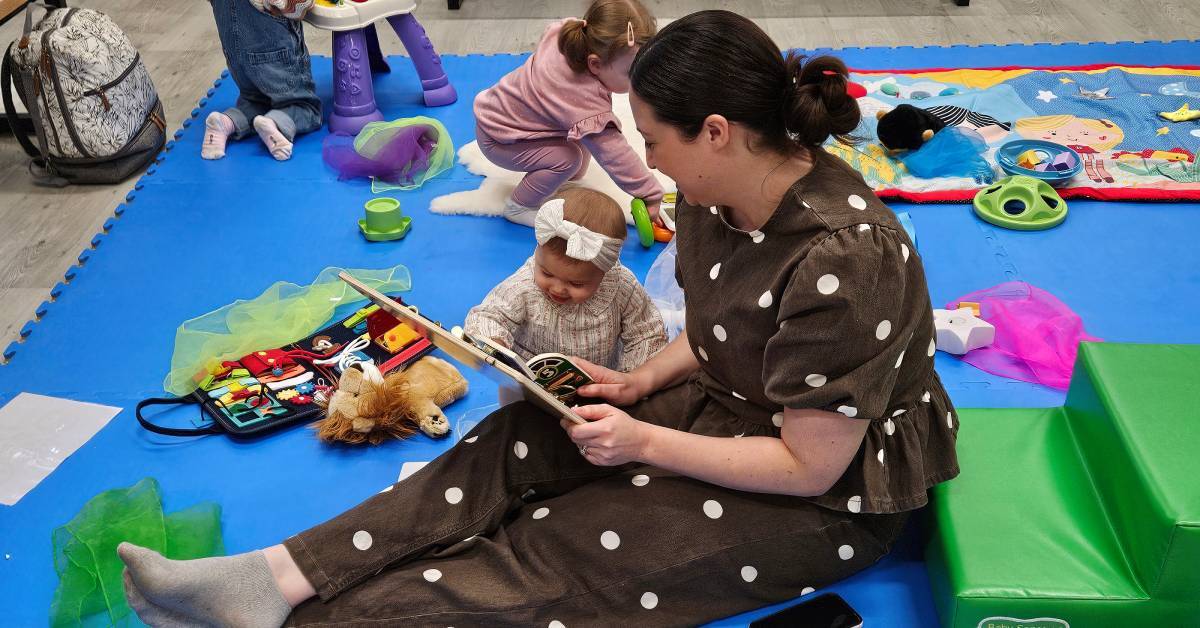
A mum reads to her baby during a session at Babyzone Grimsby. Photo credit: Babyzone.
How important is socialisation in child language acquisition?
The interaction engine is a system for social networking and mutual understanding.
Firstly, infants must learn how co-ordinate social interaction with others, so they can become part of a family and community and their activities. Once socialised, they then learn language as the information exchange system which enables them to understand and participate in joint activities within their community.
How does neurodiversity relate to the interaction engine?
Language always dominates the debate.
However, it is important to remember that we have two separate systems we can use to communicate with each other, and we can have different proficiency levels in the two systems. We have all met people who are fantastic non-verbal communicators who can get things done in countries where they can’t speak a word of the language. We’ve possibly all also met the opposite – people who have very high levels of language knowledge but who are hopeless communicators.
When we have a problem accessing one resource we can improvise with the others.
We need to get the message to both neurotypical and neurodivergent people that they have two systems and many resources to forge their own communicative style in talk and compensate for any problems. In this way, a person with a language disorder who could utter only three words (but whose interaction engine was intact) could still converse inventively at length with family and friends.
According to Levinson (2025:157-8), the most striking evidence for the ‘packaged’ nature of the interaction engine is the existence of a condition in which all its key properties are lacking, namely autism spectrum disorder. I take this to refer to the most severe cases of autism in which communication is most difficult.
Does the interaction engine differ around the world?
A number of studies have demonstrated the universality of the mechanisms of turn-taking, sequence, and repair across a range of unrelated languages. This suggests that the interaction engine is nearly uniform across the species.
The interaction engine is a single shared infrastructure, with just some cultural variability and evolution.
Personally, I have introduced the mechanisms to many students from around the world in my teaching for over 20 years. I always asked them if the mechanisms worked in the same ways in their own language and culture and they all agreed that they were fundamentally the same, with the occasional cultural variation. For example, in some cultures it is considered polite to decline an offer twice before finally accepting.
How does the interaction engine feature in multicultural or multilanguage homes?
Because the interaction engine is the system for ensuring mutual understanding, it is key in multilingual homes, because you can codeswitch, using different languages in the same turn while maintaining meaning.
When did the interaction engine begin developing in humans?
The evolutionary story is very long and complex, but here’s an abridged version.
Recent studies of interaction in other great apes suggest that the rudiments of the interaction engine first evolved millions of years ago, with different versions evolving for different species.
Having developed robust interaction engines, groups which had evolved in different cultures and with different languages could still communicate.
Levinson estimates that the interaction engine goes back around two million years. Most estimates for the emergence of language are around 100,000 years ago, before Homo sapiens spread around the world. As they started to migrate, language began to diversify into thousands of new languages which enabled processing of new information in ways best suited to their new environments and societies.

A toddler navigates the balance beam in the soft play area at Babyzone Croydon. Photo credit: Babyzone.
Why is this not being studied more widely?
Since we acquire the interaction engine before language, our knowledge of it is more deeply recessed and implicit than even that of our first language. Furthermore, no-one has ever needed to learn a new interaction engine together with a new language. It has therefore been ‘taken for granted’ or ‘seen but unnoticed’.
The most ancient and fundamental system involved in human spoken communication has been obscured by its younger partner, the flashy upstart of language. This was partly because language got itself a different partner about 5,000 years ago, namely the system of writing.
For thousands of years, linguistics has been based on written language, as it provides a permanent record. This meant that until the 1960s, the interaction engine was excluded from research. Then came audio recording and conversation analysis, which developed a framework for what we now refer to as the interaction engine.
Baby communication can be researched, but only if we start from the baby’s perspective, not that of the adult researcher, and only if we forget about language for a moment and consider how babies participate in interaction.
Our specific innovation has been to study language and the interaction engine as two separate systems which work in combination to enable talk, using complexity theory and information theory. We were then surprised and delighted that Babyzone, an organisation promoting infant social interaction, loved the concept of the interaction engine as a separate and vital system to be studied seriously.
What can families do to help babies develop the skills they need?
Research is confirming what all parents know. We should spend as much time as we can interacting with our children and responding to what he or she does. Look for signs of change and development and respond to these. Anything interactional is valuable. Be sensitive to patterns and respond to them, which is probably what you’re already doing. Repeat successful interactions; if blowing raspberries gets a smile, keep blowing raspberries. All parents know that routines matter and this applies as much to interaction as to anything else.
It is important to remember that when babies have learned the interaction engine, they can learn any language. Get yourself onto the floor and see the world from a child's perspective. The specific activity matters far less than the exchange itself, learning turns, and sequences.
You might also like:
- discover the work of the author, Paul Seedhouse, Emeritus Professor of Human Spoken Interaction at Newcastle University
- listen or watch as Professor Paul Seedhouse discusses the interaction engine and baby communication on Best Beginnings - A Babyzone Podcast
- engage in study and research that makes a difference to people’s lives, at Newcastle University’s School of Education, Communication and Language Sciences
- explore ‘The Interaction Engine: Language in Social Life and Human Evolution’ by Stephen C. Levinson
- find out more about Babyzone, an organisation bringing families, practitioners and partners together to improve early-years outcomes for every child
