
A new big screen adaptation of Virginia Woolf's 1919 novel 'Night and Day' has a regional connection: directed by a Newcastle University alumna and academic, and partially filmed on location in the North East.
The film was directed by Dr Tina Gharavi, a BAFTA-nominated screenwriter, artist, and director, and Reader in Screenwriting and Film at our School of English Literature, Language and Linguistics. Read on to find out how she brought the magic of the North East of England to Hollywood.
Contents:
- Virginia Woolf's 'Night and Day'
- 'An extraordinary dream'
- Highlighting regional landmarks and talent
- Future projects
Virginia Woolf's 'Night and Day'
Described as an ‘unromantic comedy’, ‘Night and Day’ tells the story of Katharine Hilbery: a fiercely independent female astronomer living in London in 1910, and whose family’s expectation of marriage conflicts with her own passion for science, technology, and astronomy.
The film features a talented cast, including Hayley Bennett, Jack Whitehall, Jennifer Saunders, Timothy Spall, and Lily Allen, and explores the perception of female intelligence in academia in resistance to Edwardian patriarchal norms, against the backdrop of the suffragette movement.
'An extraordinary dream'
Dr Tina Gharavi, the film’s director, was born in Tehran and spent her childhood in the UK and USA before studying at Le Fresnoy, France. She came to Newcastle in 1998, joined Newcastle University’s teaching staff in 2004, and graduated in 2014 with her PhD, ‘Narrative Cannibals: Whose Story Is It Anyway? The politics of representation and the veracity of the image in the age of digital storytelling’.
Her feature debut, ‘I Am Nasrine’ (2012), was nominated for a BAFTA and commended for its sensitive exploration of displacement and resilience. She was elected to the BAFTA Academy in 2017 and made a Fellow of the MIT Open Documentary Lab. In 2026, her personal archives were acquired by the British Film Institute (BFI) and were the subject of the BFI South Bank Season retrospective Beyond the Frame in January 2026.
Her newest directorial venture has her recreating Edwardian London using regional scenery from around the North East. Dr Gharavi has described bringing Virginia Woolf’s story to life as 'an extraordinary dream'.
'I have always wanted to tell stories about women who resist the roles imposed on them, and Woolf understood that impulse better than almost any writer. The question at the heart of this film – must a woman choose between love and ambition? – is as alive today as it was in 1910.' Dr Tina Gharavi
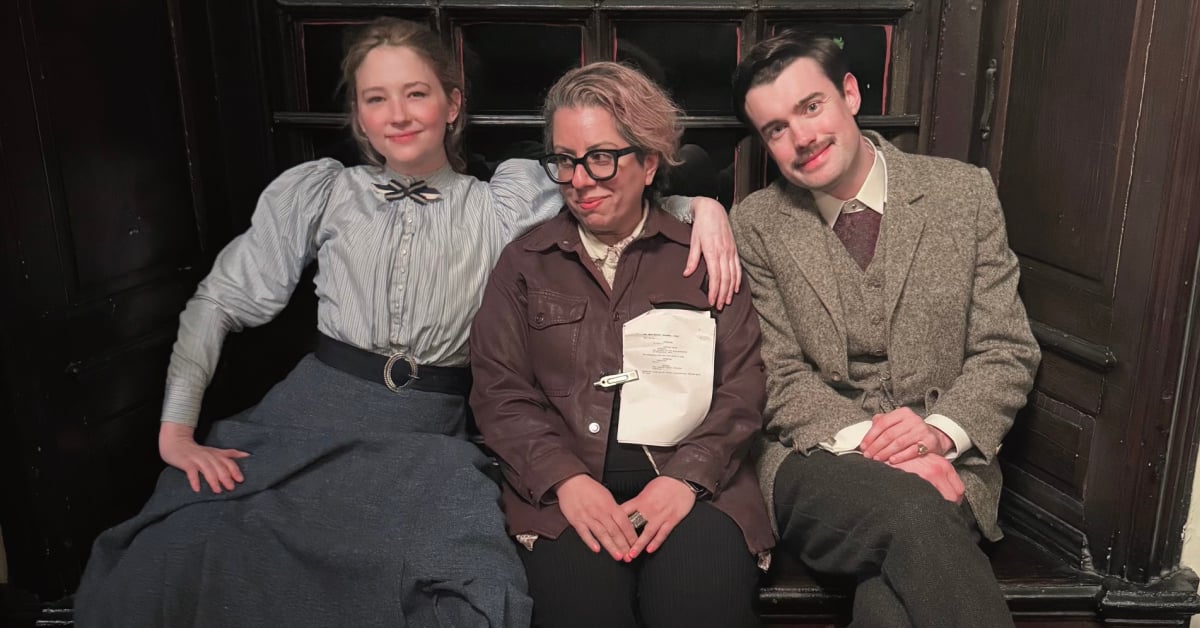
Left to right: Hayley Bennett, Tina Gharavi, and Jack Whitehall. Image credit: Bridge + Tunnel
Highlighting regional landmarks and talent
Dr Gharavi’s passion for the North East of England took shape in her directorial decision-making. While Dublin was the filmmakers’ choice for filming locations, she convinced them to change to Newcastle and the surrounding area, knowing the wealth of character and unique locations the region has to offer.
Those familiar with the North East landscape may recognise landmarks in the film, such as:
- Beamish Museum: an open-air ‘living museum’ based in Country Durham, preserving urban and rural features of the North East from 1913 to 1957.
- The Literary and Philosophical Society of Newcastle upon Tyne: known as the Lit and Phil, a Grade II listed library in central Newcastle founded in 1793
- The Common Room: a Grade II listed heritage venue, home to the North of England Institute of Mining and Mechanical Engineers since 1872
- Ryhope Engines Museum: a Jacobean landmark in Sunderland
- Tanfield Railway: one of the world’s oldest operational railways, with sections dating back to 1621
In the early production stages, Dr Gharavi was hopeful that Newcastle University’s campus could also be used for some scenes, but this wasn’t possible due to scheduling conflicts. Despite this, Dr Gharavi made sure that Newcastle University was still an integral part of the film by offering students the chance to gain invaluable work experience on set. Production staff and extras in the film were campus faces, ranging from students to teaching staff.
'I can't wait for North East audiences — who helped us make this film — to be among the first to see it.' Dr Tina Gharavi
'Night and Day' continued to pay homage to its Northern setting by holding its premier at the Tyneside Cinema on 15 June, before being released in cinemas nationally on 19 June.
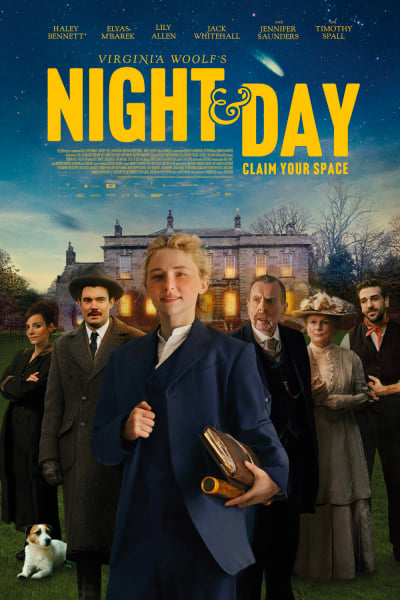
Film poster for 'Night and Day'. Image credit: West End
Future projects
Dr Gharavi continues to teach at Newcastle University’s School of English Literature, Language, and Linguistics as Reader in Screenwriting and Film, where she supervises practice-based research in screenwriting, adaptation, and documentary.
As well as her teaching responsibilities at Newcastle University, Dr Gharavi’s filmmaking career is going strong. She has several projects currently in motion, including a biopic of Iranian poet Forough Farrokhzad – which is being executive produced by Wes Anderson – and a feature film titled ‘The Good Iranian’, in collaboration with Film4.
You might also like:
- read the press release: Academic’s new film premieres in North East ahead of national release
- read our interview with Dr Tina Gharavi: From campus to cinema screens: Alumni-directed film adaptation hits the big screen this month
- learn more about Dr Tina Gharavi, Reader in English: Screenwriting and Film
- explore Dr Gharavi’s personal website, Bridge + Tunnel Productions
- find out how our School of English Literature, Language, and Linguistics produces world-leading research in areas of Literature, Creative Writing, English Language, and Linguistics

Header image credit: Bridge + Tunnel