At the core of the United Nations' 2030 Agenda for Sustainable Development is the pledge to 'leave no one behind' – in particular, to ensure inclusive participation for vulnerable and marginalised populations.
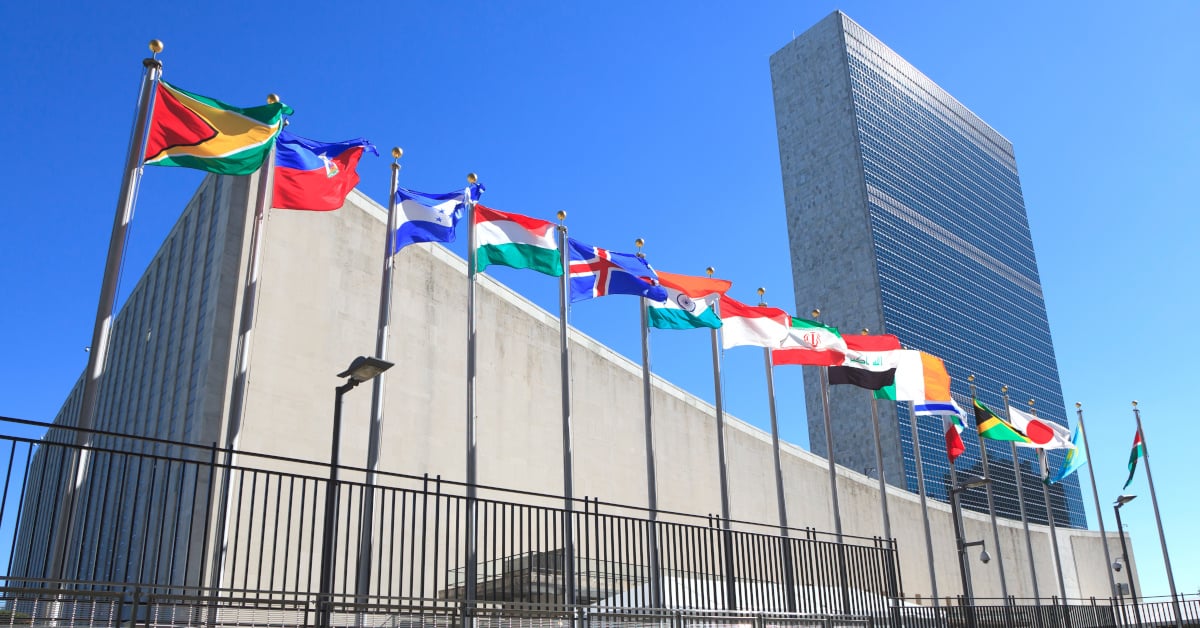
Newcastle University supports the UN's 17 Sustainable Development Goals (SDGs) as a global roadmap for sustainable development and as closely aligned with University values of environmental and social justice. At this year's UN High Level Political Forum (HLPF) at UN Headquarters in New York, Newcastle University collaborated with the organising team to support this commitment by the funding attendance and participation for Dr Vinayaraj Veesadan Kuttappan: representing for Communities Discriminated on Work and Descent (CDWD).
We spoke with Dr Graham Long, Senior Lecturer from our School of Geography, Politics and Sociology, about Dr Vinayaraj's plenary intervention at the official HLPF plenary on 'Strengthening alliances for SDG implementation', and why inclusive participation remains essential to achieving the promise of the 2030 Agenda.
Contents:
- High-Level Political Forum 2026
- Dr Vinayaraj's speech on 'strengthening alliances for SDG implementation'
- The wider importance of supporting inclusive dialogue
High-Level Political Forum 2026
The United Nations High-level Political Forum on Sustainable Development is the UN’s central annual event to review the progress towards the 2030 Agenda for Sustainable Development and its 17 Sustainable Development Goals (SDGs). The event is attended by ministerial and high-level representatives of governments, heads of UN entities, academics, and representatives of stakeholder constituencies from around the world.
The HLPF 2026 took place from Tuesday 7 July to Thursday 16 July at UN HQ in New York. The theme of the forum was 'Transformative, equitable, innovative and coordinated actions for the 2030 Agenda and its SDGs for a sustainable future for all'. The SDGs are a universal, integrated framework. On a rolling basis, the annual HLPF aims to take stock of progress on the SDGs across all areas and all countries. The 2026 HLPF reviewed:
- implementation on a sub-set of the SDGs: Goal 6 (Clean Water and Sanitation), Goal 7 (Affordable and Clean Energy), Goal 9 (Industry Innovation and Infrastructure), Goal 11 (Sustainable Cities and Communities), Goal 17 (Partnerships for the Goals)
- Voluntary National Reviews from 36 countries
- global progress and challenges, culminating in negotiation and agreement of a Ministerial Declaration on next steps
Working with the organisers and stakeholder groups, Newcastle University identified an opportunity to help enable representation for a marginalised population and funded attendance for Dr. Vinayaraj Veesadan Kuttappan.
Dr. Vinayaraj Veesadan Kuttappan is Senior Research Coordinator at The Inclusivity Project (TIP) and serves on the Secretariat of the Global Forum of Communities Discriminated on Work and Descent (GFoD). He holds a Ph.D in International Politics. He coordinates research, programme implementation, and global advocacy initiatives aimed at advancing the rights of Communities Discriminated on Work and Descent (CDWD), including Dalit and other historically marginalised populations. He represents the Stakeholder Group of Communities Discriminated on Work and Descent (SG CDWD) in United Nations sustainable development and human rights processes.
TIP is an international non-profit organisation working to eliminate discrimination based on work and descent (DWD) and to advance the rights of Communities Discriminated on Work and Descent, including Dalits, Burakumins, Roma, Quilombola, Palenque, Haratin, Osu, Mbororo and other historically marginalised communities. Through research, policy advocacy, leadership development and partnerships with community-led organisations, TIP supports evidence-based action to promote equality, social justice and inclusive sustainable development. TIP holds Special Consultative Status with the United Nations Economic and Social Council (ECOSOC) and works with partners across Africa, Asia, Europe and Latin America to ensure that the voices and experiences of marginalised communities inform national, regional and global policy processes. TIP, supported by Global Forum of Communities Discriminated on Work and Descent (GFoD), is working towards a Declaration at the UN protecting and promoting the rights of CDWD.
Dr Vinayaraj's speech on 'strengthening alliances for SDG implementation'
On 10 July 2026, Dr Vinayaraj spoke at a high-level dialogue alongside Mr. Guy Ryder, Under-Secretary-General for Policy, Executive Office of the Secretary-General (EOSG), Ms. Claudia Fuentes Julio, Assistant Secretary-General for Human Rights, and Ms. Yugratna Srivastava, representative of the Major Group for Children and Youth.
Dr Vinayaraj presented on the question: 'How can insights and experiences from frontline rightsholders be leveraged to accelerate implementation of the 2030 Agenda and its SDGs?'. You can read their prepared statement in full below:
| We are now just a few years away from 2030. Yet for millions of people living at the margins, the Sustainable Development Goals are not failing because they are too ambitious. They are failing because they have not reached those who need them the most. For the most marginalised communities – including communities discriminated on work and descent, and other groups – poverty, discrimination, violence, insecure livelihoods, lack of quality education, lack of access to water, unequal healthcare and exclusion from decision-making remain everyday realities. While national reports often speak of progress, entire communities continue to live outside the reach of development. The greatest barrier to accelerating the SDGs is not a lack of knowledge; it is a lack of political will to recognize the knowledge, leadership and solutions that already exist within frontline communities. They are not merely beneficiaries of development; they are the first to identify emerging challenges, the first to respond to crises, and too often the last to be heard. They know where discrimination denies access to services, why children; especially girls; continue to drop out of school, where climate shocks are destroying livelihoods, and where public resources fail to reach those most in need. Their lived experience is evidence. Their voices are data. Their leadership is indispensable. Across our global network, we have seen what becomes possible when grassroots organizations led by frontline rightsholders are trusted as equal partners. In Africa, sustained advocacy at the national and regional levels, contributed to the African Commission on Human and Peoples’ Rights (ACHPR) adopting Resolution 619, a landmark commitment to protect and promote the rights of Communities Discriminated on Work and Descent. In South Asia, for instance in Nepal, Dalit-led organisations have worked with local governments to document structural discrimination based on caste, monitor public services, and strengthen inclusive local development planning. In Europe, Roma communities generated evidence on exclusion from essential services and advocated for more equitable access to water, education, healthcare, and housing. For many grassroots organizations, reaching international spaces such as the HLPF requires overcoming significant financial, institutional and structural barriers. However, communities have generated their own evidence, documented human rights violations, monitored SDG implementation, engaged with governments, contributed to Voluntary National Reviews and influenced regional and international human rights mechanisms. These are not isolated success stories; they demonstrate what inclusive partnerships can achieve when communities are empowered rather than spoken for. But let us also be honest. Too often, citizen-generated data is welcomed in dialogue but ignored in decision-making. For CDWD, the stigma of inherited status and discrimination adds another layer of exclusion; we are too often invited to be visible, but not to be influential; consulted, but not trusted; represented, but not empowered. Communities cannot be expected to deliver change without the resources, recognition and political space to lead it. This must change. To accelerate the 2030 Agenda, we need transformative commitments. The question is whether we are prepared to shift power to those who have carried the burden of inequality for generations. If we truly want to leave no one behind, then those who have been left behind for the longest must finally be at the centre of decision-making; not as observers, but as leaders, partners and co-creators of sustainable development. Only then will the promise of the 2030 Agenda become a reality for everyone. |
The wider importance of supporting inclusive dialogue
The SDGs, famously, are a big agenda – 17 Goals, with 169 Targets, and 234 indicators – prompting a rich debate for academics around mapping, measuring, and modelling these different elements and their interactions. But the norms and ideas at the core of the goals, and the political processes and institutions that have grown alongside them, are just as critical – perhaps more so – to understanding, assessing, and realising the SDGs.
The 'leave no-one behind' pledge in the SDGs is critical to the agenda because it speaks to issues of fairness, equality, inclusion and human rights: in terms of outcomes, but also in terms of data and participation, as Dr Vinayaraj highlights. It is a difficult challenge, too, because marginalisation finds expression in mutually-reinforcing barriers across all these dimensions. Not just barriers to fair outcomes, but to the visibility of marginalised populations in SDG data and the meaningful participation of these populations in discussions and decisions. In this context, citizen-generated data is a prominent 'buzzword', allowing marginalised groups to participate through presenting evidence and addressing data gaps. But as Dr Vinayaraj points out, generating data is not enough.
'If we truly want to leave no one behind, then those who have been left behind for the longest must finally be at the centre of decision-making; not as observers, but as leaders, partners and co-creators of sustainable development.' Dr Vinayaraj
The institutions that came into being alongside the SDGs – especially the High-Level Political Forum, but also the regional fora (and the different institutions put in place at the national level by governments) – are another piece of this puzzle. At their best, they promote learning and partnerships across stakeholder sectors and countries. They also reinforce these core norms of the SDGs; 'leaving no one behind', but also the indivisibility of environmental and social challenges, the universal ownership of the agenda, and participation of different stakeholder groups, including academia.
The rules ('modalities', in UN-speak) for the HLPF allow all stakeholders, including marginalised groups, to participate and over the years I've seen the importance of this. But the HLPF is still an in-person event, based in the global north, at an institution that is built around 'states' even as it strives to connect 'peoples': this presents challenges for the UN and stakeholder coordinators in trying to ensure an inclusive event – sharpened in the context of the financial constraints facing the UN system.
Over the years, and alongside university colleagues, I’ve worked for and with the UN on the SDGs and the importance of 'leaving no one behind' – and also worked with a range of groups representing marginalised populations. My current research addresses the role of collaboration in the 2030 Agenda for Sustainable Development, even as we move, in a fractured multilateral system, towards the launch of the post-2030 process at next year’s HLPF. This year, we collaborated with the organisers to explore how we could help realise a more inclusive HLPF, and – with thanks to everyone who helped to make this happen at short notice – we were able to meaningfully support inclusive global review of the SDGs in a way that reflects Newcastle as a global, civic, university.
This work was supported by Research England’s Quality Related (QR) Policy Support Fund at Newcastle University.
You might also like:
- discover the details behind the High-Level Political Forum 2026
- know about Global Forum of Communities Discriminated on Work and Descent
- find more about Stakeholder Group of Communities Discriminated on Work and Descent
- read about the vital work of The Inclusivity Project
- learn more about:
- Dr Graham Long, Senior Lecturer in our School of Geography, Politics, and Sociology
- Dr Vinayaraj, Senior Research Coordinator, The Inclusivity Project
- find out more about Newcastle University’s commitment to the Sustainable Development Goals
- explore research from our School of Geography, Politics, and Sociology that is internationally-focused, informs public debate, and contributes to public policy
