-4.png)
In 2023, the Creative Industries Policy and Evidence Centre adopted a new dual structure – with offices in both Newcastle and London. But what has happened since?
Alice Kent, Head of Communications, reflects on the highlights from the last two years.
What is the Creative Industries Policy and Evidence Centre?
In the summer of 2023, from within its Business School, Newcastle University became the host of the Creative Industries Policy and Evidence Centre (Creative PEC). Led by Newcastle University alongside the Royal Society of Arts, and funded by the Arts and Humanities Research Council, the Creative PEC aims to benefit the creative industries across the whole of the UK.
The Creative Industries cover several subsectors, from architecture and advertising to fashion and film. Every time you watch a film or TV show, play a video game, go to a gallery, or buy a pair of jeans – you are part of the creative economy. The UK is considered a world-leader in this sector, and as well as making our lives more joyful and entertaining, it’s big business.
Achievements in a time of change
The past two years have been a time of enormous political and economic change for Creative Industries policy.
Shortly after taking office in 2024, the Labour Government named the Creative Industries as a priority sector in the new Industrial Strategy. At the start of 2025 the new Taskforce met for the first time, with our Director, Professor Hasan Bakhshi invited to join the team.
Subsequently, the Sector Plan for the Creative Industries was published this summer. This is part of a wider policy landscape with new announcements coming on creative education, creative clusters funding, and the Arts Council England review. The new Sector Plan places the Creative Industries on the same footing as other major industrial sectors at the heart of government.
We’re now at the midway point of the new AHRC grant for the Creative PEC and so it seems a good time to take stock and look at what’s been achieved and what this impact means for the wider public.
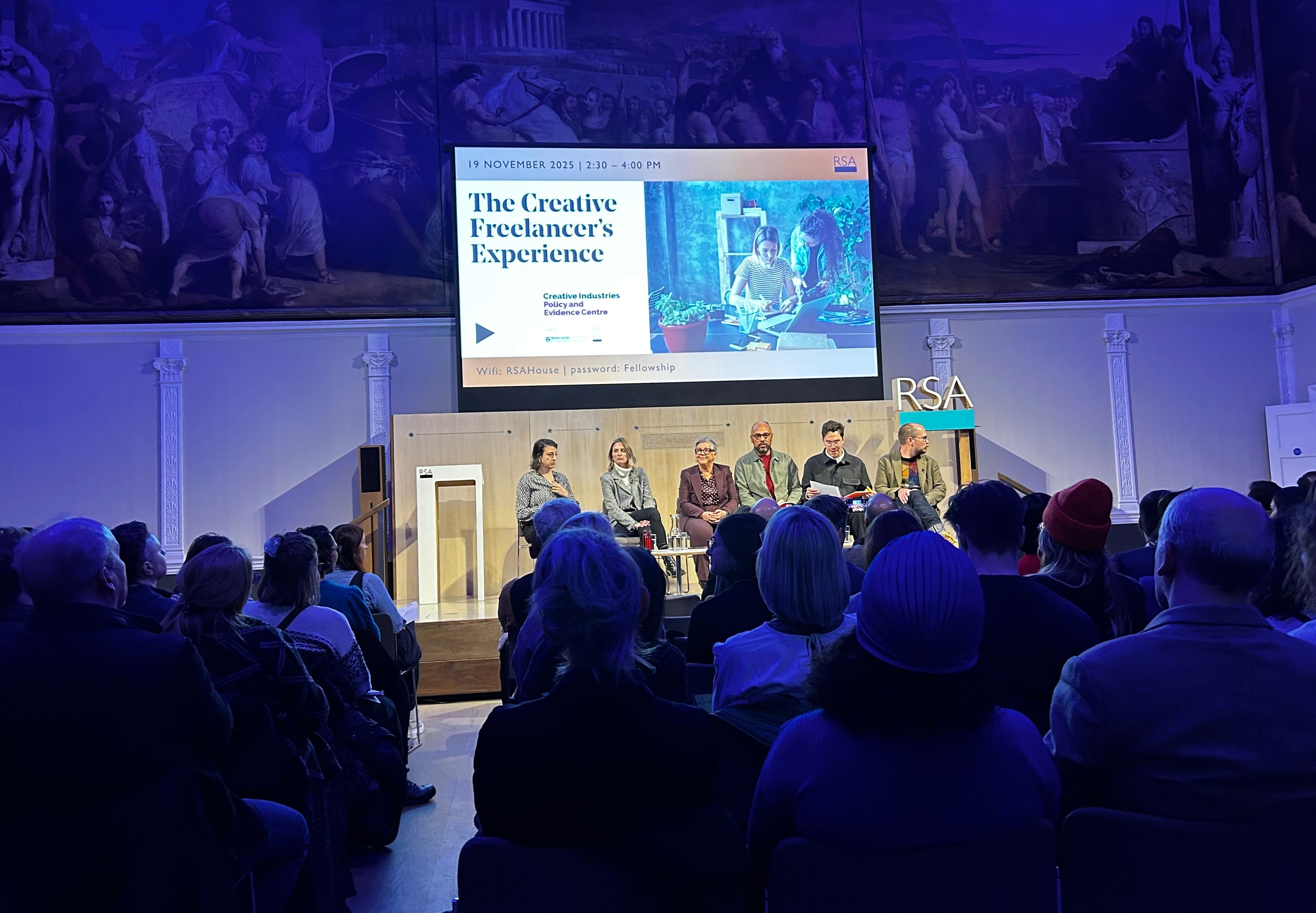
A panel of experts gathers at the launch of the latest State of the Nations report from Creative PEC on the Arts, Culture and Heritage workforce.
1. Shaping policy
It’s not always easy to pinpoint which activity (new report, passing conversation, or carefully planned event) led to a specific policy intervention, yet seeing twenty-six references to twenty separate Creative PEC reports in the new Sector Plan is a clear indication that our work is cutting through.
The first half of 2025 was especially busy. The rapid formation of the Taskforce and the new Sector Plan called for frequent requests for data and timely insight on a range of topics. The Creative PEC’s research on access to finance and public research and development (R&D) investment was critical in unlocking commitments from the British Business Bank and UK Research and Innovation (UKRI) to increase investment in the Creative Industries. We also led on the development of specific policy announcements, including commitments by HM Revenue and Customs (HMRC) to issue new guidance for creative industries applicants for R&D tax relief and by the Department for Culture, Media, and Sport (DCMS) to publish more official statistics on the sector.
While this might sound technical or remote, what it translates to is more ways to support creativity across the country.
The Creative PEC’s approach as an ‘embedded knowledge exchange’ centre was put into action with rapid evidence gathering for both the DCMS and Department for Business and Trade (DBT). The Sector Plan commits to working with the Creative PEC on ongoing Skills Audit work, the Creative Business Panel and new research on ‘createch’: where creativity meets the use of advanced technologies.
Plans for a new Freelance Champion for the Creative Industries and the focus on place-based investment means even more good news for creatives. Our Head of Policy, Bernard Hay, provided more comment in The Conversation.
2. Amplifying research in the media
The Creative PEC includes an internal research unit led by Professor Giorgio Fazio and a network of consortium partners: Newcastle University, Sheffield University, Sussex University, and Work Advance. Our focus is on how to make sure the right data is available to policymakers at the right time.
Since the start of the current AHRC award, we’ve launched the new State of the Nations series. This helps with brand recognition, supports engagement and creates authoritative reference works to help shape policy. We’ve delivered twelve State of the Nations reports to date, two of which launched through high-profile exclusives with Channel 4 News - Creative Education and Arts, Culture and Heritage: Audiences and Workforces. The Channel 4 YouTube clip of this second paper had 2.1m views on X, showing that the research cuts through not just in policy circles but with the wider public. The report showed that just 8.4% of people working in Film and TV are from a working-class background and generated a lot of discussion around class and access to working in arts, culture and heritage. The report was referenced by Secretary of State Lisa Nandy in her keynote for the Royal Television Society, by screenwriter James Graham in his MacTaggart Lecture and by Carole Vorderman in her alternative MacTaggart Lecture.
For our research to have impact, it’s essential that it can be used by people in different places to support their policy work. As such, with Sheffield University we published a new dashboard that enables every Local Authority in England – at a click of a button – to access Arts, Culture and Heritage workforce data at electoral ward level. This access helps each Local Authority to identify specialisms, microclusters, and guide their own Creative Industries strategy.
3. Partnership working to drive the agenda
Working in partnership is essential to expanding sector expertise and leveraging maximum impact from our AHRC grant.
So far, we’ve worked with several national and international partners, including the DCMS and Department for Education (DfE) on Specialist Creative Education, the Organisation for Economic Co-operation and Development (OECD) on Innovation and Productivity, Creative UK on Access to Finance, and we’re just kicking off a new project with UNESCO to quantify the economic and non-economic impacts of its designated sites.
We’re also currently working with partners across sixteen research projects that will help plug gaps in the evidence base for policymakers for the first time. For example, we’re about to write up the findings of our pilot study for our Creative Business Panel, led with CoStar Foresight Lab, in partnership with DBT and supported by DCMS. It will track the behaviours, performance and experiences of businesses across all creative sub-sectors.
Furthermore, with researchers at Melbourne and Sussex Universities, we will soon be publishing a discussion paper presenting the findings of research on what impact generative AI tools are having on employers' demand for creative skills, and with Figurative we’ll soon publish work on sustainability in the culture sector. We’ve also held an event on freelancing within the creative industries.
We’ve also reimagined our network of Creative Industries Champions, who share on the ground insight to help shape our policy and research. Together with our Research Fellows Network, including Early Career Researchers from across the globe, these networks help ensure joined-up thinking between our policy, research, and industry activity.
And this is just a snapshot of our activity.
4. Global north and south
The Creative PEC, together with the British Council, convenes a unique international forum focussed on creative economy policy with representatives from both the global north and south.
The Global Creative Economy Council (GCEC) – managed by the PEC’s Deputy Director Karen Brodie with Chair Marta Foresti – brings together diverse expert perspectives to tackle challenges and opportunities that are global in nature. From cultural tourism in the Maldives, to creative industries clusters in Egypt, the range of perspectives the GCEC gives ensures our work is truly international in scope and impact.
A national north and south approach
Our dual North/South approach has enabled us to harness the expertise of colleagues at Newcastle University and demonstrate the value of the creative industries across the whole country and internationally, too.
Whilst moving to Newcastle University Business School in 2023 brought huge operational change, it also opened up enormous opportunity and supported a more inclusive approach to regional and national policy. For example, bringing together the powerhouses that are the RSA, Newcastle University, and Arts Council England has resulted in new research on Creative Corridors – a concept which could drive UK growth through learning from innovation superclusters, such as Silicon Valley. We’ve also spearheaded new local and regional work in the North East of England by convening roundtables at the Darlington Economic Campus and supporting the formation of One Creative North.
Looking ahead...
It’s been a monumental two years. Thanks to the ongoing support of the AHRC, we’ve successfully moved to a new operational structure, joined a university that identifies the Creative Industries as a strategic priority, supported a new ten-year national Creative Industries Sector Plan, cemented our State of the Nations series as a trusted resource within the sector, developed our international presence and initiated sixteen research projects with a range of partners.
None of this would be possible without strong partnerships in place.
The future for the Creative Industries is enormously exciting and yet not without significant challenges, too. A foundation of good policy is having robust, timely and independent evidence. As Hasan recently wrote for Arts Professional, the UK’s renewed focus on the Creative Industries: ‘places a responsibility on those of us working across the UK’s brilliant, dynamic and world-leading Creative Industries to seize the day, to present a vision of the myriad ways in which the Creative Industries contribute, not just to growth and the jobs of the future, but also the kind of future we want to live in. A future that is inclusive, fulfilling, sustainable, where everyone benefits from creative education, not just the privileged, and where technology enhances individual flourishing, rather than shutting it down.’
Carpe diem!
You might also like...
find out more about the Creative Industries Policy & Evidence Centre (Creative PEC)keep up to date with all Creative PEC report launches and sign up to their newsletter where they also share policy briefs and UK government submissions
explore how we’re nurturing arts and culture at Newcastle to positively challenge and change our world
explore the work of the Royal Society of Arts (RSA)
find out more about Newcastle University’s Business School
discover more about the work of Arts and Humanities Research Council (AHRC)
read the government policy paper: The UK’s Modern Industrial Strategy: Creative Industries Sector Plan
read the blog: Creative PEC: supporting inclusive and sustainable growth of the UK’s creative industries
