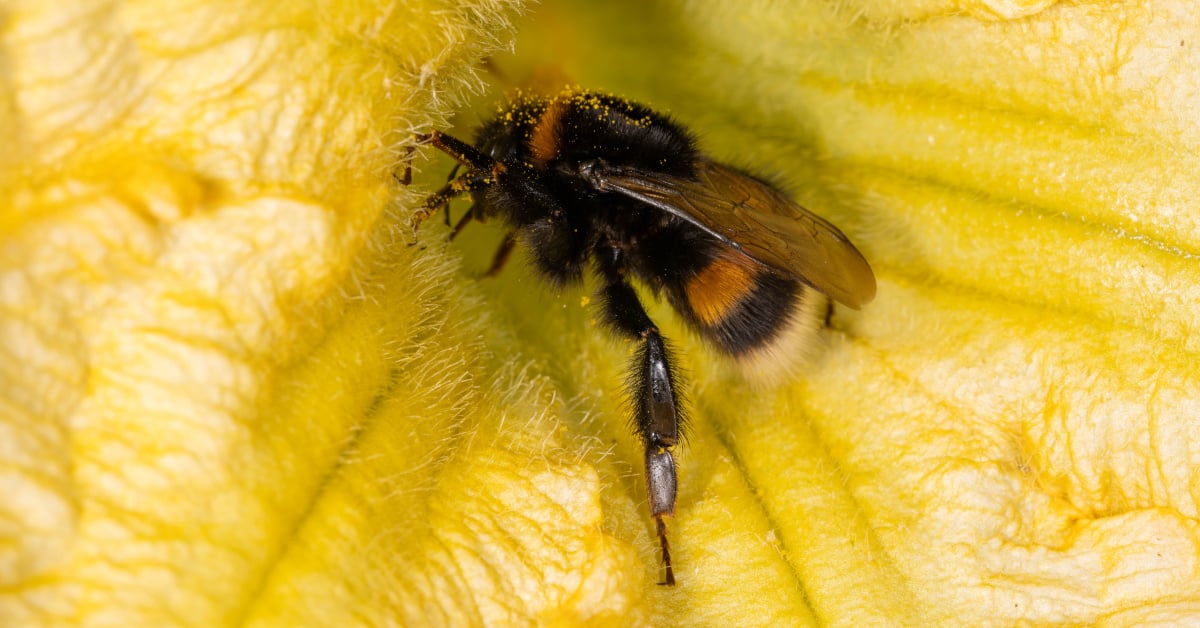
Not all humans can say they work well in a high-pressure environment. But according to new research, one creature has managed to turn stress into a superpower.
Researchers from Newcastle University and the University of Birmingham have discovered that putting bumblebees in stressful situations results in an insect with sharper vision and faster reactions. Read on to find out more.
Contents:
- Stress and decision-making
- Training bumblebees
- The experiment
- The effects of stress on bumblebees
- Understanding stress
Stress and decision-making
We understand that acute stress in humans is known to influence decision-making, altering the perception of basic visual features and fine-tuning vision to support faster responses under threat. Stressed mammals not only detect threats quicker but also demonstrate enhanced goal-directed visual search performance. This indicates that being in a high-vigilance state could enhance the visual system’s ability to detect relevant information in the surrounding environment.
'While stress is negative, it can prepare an individual for future challenges by changing how they respond.' Dr Vivek Nityananda, Senior Lecturer at Newcastle University
Pollinators such as bumblebees rely heavily on vision for navigation and foraging, and are exposed to many stressors such as natural predators and human-caused environmental challenges. While stress has been shown to alter bee visual decision-making, its effects on visual processing remain unexplored. This became the topic of this study headed by Dr Vivek Nityananda, Senior Lecturer at Newcastle University, and Dr Olga Procenko, Postdoctoral Researcher at the University of Birmingham.
Training bumblebees
The team investigated whether exposing bees to stress – with vigorous shaking mimicking predatory attacks – influences their visual perception. Specifically, they examined if stress affects the perception of:
- low-level visual features
- stimulus contrast
- spatial frequency
- choices and decision speed in a dual-choice discrimination task
The experiment took place within a custom-built Y-shaped maze, complete with training apparatus. Four colonies of commercially raised buff-tailed bumblebee (Bombus terrestris) were transferred into a plastic nest box, with each colony given their own separate box. This was connected to the Y-maze via a transparent acrylic tunnel, with shutters controlling the bees' access to the maze.

Diagram of the training apparatus used to train bumblebees and gauge their response to making decisions while under stress.
Before training, the bees were presented with with a choice between two black and white striped patterns for the first time: one positioned horizontally and the other vertically. The reward chamber on the arm with horizontal grating contained a sugar reward (0.2 ml, 50% w/w), while the reward chamber on the side of the vertical grating contained distilled water (0.2 ml): the horizontal grating was always associated with a reward, and the vertical grating with water.
During the training phase, the bees were allowed to access the reward chamber freely, and presented with horizontal and vertical patterns as before. The bees were trained to tell the difference between rewarding horizontal patterns and unrewarding vertical ones, on one spatial frequency and one contrast. They were then tested on similar pairs of patterns that had varying spatial frequencies and contrasts – to determine their spatial resolution and contrast thresholds.
The experiment
After training, individual bees were randomly allocated to one of two groups: predatory attack simulation by shaking, or an unmanipulated group that served as a control. The bees in the shaken group were individually subjected to 60 seconds of shaking at 1200 rpm using a Vortex-T Genie 2, while the other group was left alone.
Before entering the flight arena, the bee was allowed to enter a custom-made tagging cage, which was softened by sponge to prevent physically harming animals while shaking. After the shaking, the bee was released into the tunnel connected to the Y-maze via an opening on the top of the tunnel. The bee was allowed to enter the Y-maze for testing as soon as it was ready, to seek out and forage for rewards.
All test trials were recorded using a Huawei Nexus 6P phone, capturing video at 120 frames per second (fps). During the experiment, the following time points were recorded:
- when the bee entered the Y-maze
- when the bee crossed the decision line
- when the bee entered the reward chamber

Examining how stress affects bumblebee behaviour could inform future studies. Image credit: Dr Vivek Nityananda
The effects of stress on bumblebees
The researchers discovered that at higher contrast levels, there was an increase in the likelihood of bees making the correct choice. This trend was consistent across both treatment groups, as shaken bees showed no significant difference in their likelihood of making the correct choice compared to control bees. This demonstrates the ability of bees to accurately tell the difference between the patterns, even as contrast levels decreased, regardless of which group they are from.
'Stress increased the bees' readiness to act on their early perceptual judgment and commit to a choice and do so faster, without compromising accuracy.' Dr Olga Procenko, Postdoctoral Researcher at the University of Birmingham
The results suggest that not only were stressed bees more likely to commit to a choice, but they did so significantly faster when their early perceptual decisions were accurate.
Understanding stress
The results of the experiment indicate that acute stress influences both decision speed and outcome. Shaken bees were less likely to omit making a choice. When they did choose, they responded with speed and accuracy.
'In bumblebees, we found that stress sharpens aspects of their vision and helps them respond more quickly to what they see,' says Dr Vivek Nityananda, lead author of the study. 'Rather than overwhelming the system, it could help prioritise the most relevant information, allowing bees to act rapidly and effectively in potentially threatening situations [...] Understanding how stress reshapes perception is important not just for studying animal behaviour, but for a much wider range of fields. Whether we’re looking at how the human brain responds in stressful environments or designing artificial systems that need to make rapid decisions based on visual input, these are shared challenges.'
Dr Olga Procenko, Postdoctoral Researcher at the University of Birmingham, agrees: 'What's remarkable is that despite the very different visual worlds these animals inhabit, the underlying principle appears to be the same - stress doesn't simply impair or enhance vision, it reshapes it in ways that are ecologically meaningful. For bees, this may mean an increased ability to detect small details, like a camouflaged spider hiding on a flower.'
It is thought that this study could impact research into the development of robots designs to work under pressured situations.
The stress of a bumblebee may seem small by comparison, but by studying how it reacts to pressure, it could help us gain some big insights into perception and behaviour across the animal kingdom.
You might also like:
- read the article: Acute stress modulates early visual perception and decision-making speed in bees. Olga Procenko Vivek Nityananda. Journal of Experimental Biology. DOI: 10.1242/jeb.251716
- read the press release: Stress gives bumblebees sharper vision and faster reactions
- learn more about Dr Vivek Nityananda, Senior Lecturer, and his research:
- learn more about Dr Olga Procenko, Postdoctoral Researcher at the University of Birmingham
- discover how our Biosciences research is helping people understand life at the level of molecules, cells, and organisms
