Coral reefs are among the most valuable ecosystems on our planet, yet they are rapidly declining under the pressure of climate change. Could assisted evolution help corals adapt quickly enough to endure?
Contents:
- What are corals?
- Why are coral reefs important?
- What threatens the world's coral reefs?
- What is assisted evolution?
- Assisted evolution around the world
- How is the CORALASSIST lab progressing science on assisted evolution?
What are corals?
Corals, like trees in a forest, create the complex structures that form one of the most biodiverse marine ecosystems on the planet – tropical coral reefs.
Although often mistaken for plants, corals are in fact marine animals, closely related to jellyfish and sea anemones. Found across the world’s oceans, they build shallow reef structures in tropical regions. The largest coral reef system on Earth is the Great Barrier Reef, which covers approximately 348,000 square kilometres, roughly the same size as Italy.
Why are coral reefs important?
Coral reefs support millions of people worldwide. These areas of natural beauty attract visits that support diverse tourism industries, from hospitality, transport, and local food markets to tour operations, and other small business that rely on reef-related economic activity. Globally, they generate an estimated £6 trillion annually through fisheries, tourism, and coastal protection. A healthy, well-managed reef can also provide people with 15 tonnes of seafood per square kilometre per year. Reefs also act as natural barriers, absorbing up to 97% of incoming wave energy and helping shield coastlines from storms.
Coral reefs also provide a home to nearly a quarter of all known marine species, many of which rely on the reef at some stage of their life cycle for food, shelter, or breeding. Reef-associated organisms, such as sea sponges, produce unique chemical compounds that are being researched for developing new medicines. Extracts from animals and plants living on reefs have already contributed to treatments for asthma, arthritis, cancer and heart disease.
What threatens the world’s coral reefs?
Over the last three decades, four global heatwave-driven coral bleaching events have caused catastrophic levels of coral mortality. During this time, at least one fifth of global coral cover has been lost, and projections indicate that the majority of the world’s reefs (70-99%) will be at severe risk of degradation by mid-century under predicted warming scenarios. Data from the National Oceanic and Atmospheric Administration (NOAA) confirms that over 84% of the world’s coral reefs were impacted by bleaching-level heat stress between January 2023 and April 2025.
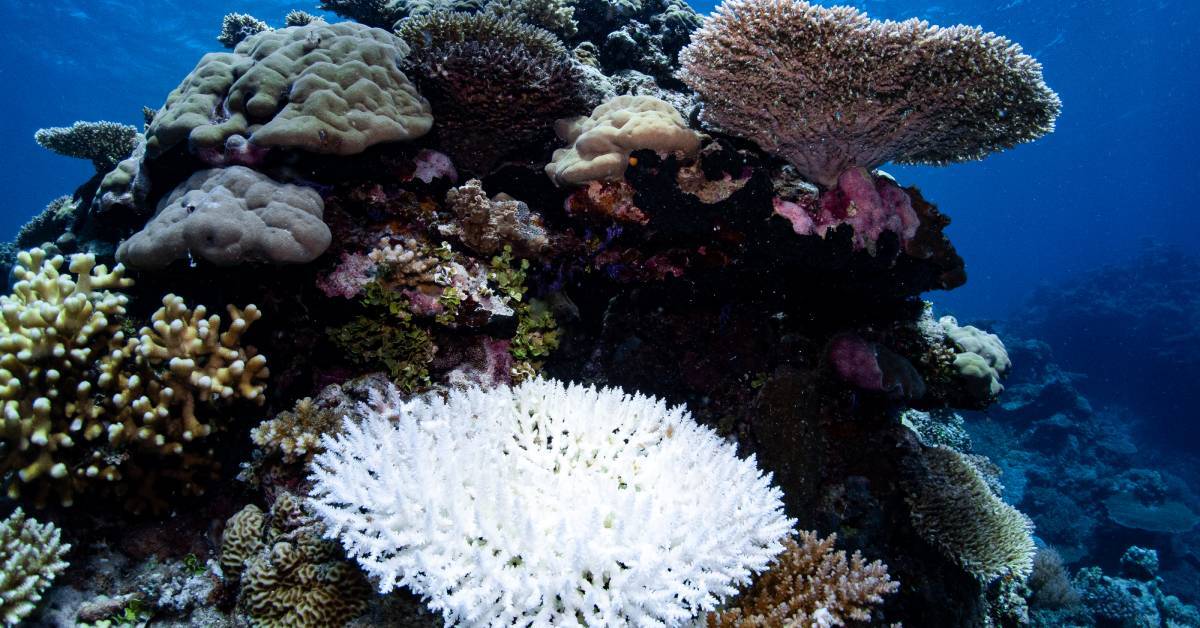
When the ocean temperatures rise beyond corals’ tolerance, they become stressed and expel the symbiotic algae (symbiodinaceae) that live within their tissues. These algae not only give corals most of their colour but also provide them with food. Without them, the corals’ white skeletons become visible, which is why this process is referred to as ‘bleaching’.

Bleached corals on a Pacific reef during the 2023 marine heatwave that triggered the worlds 4th global mass coral bleaching event Credit: Liam Lachs
As global warming accelerates, extreme heatwaves are driving mass mortality of tropical reef-building corals. Evolution of increased heat tolerance will likely be critical for some coral populations to persist, and not surprisingly, emerging evidence indicates this is already under way.
However, with the increasing frequency of marine heatwaves – projected to intensify under all plausible climate‑change scenarios – many reefs are expected to experience heat‑stress events capable of causing mass mortality as often as four times per decade by 2050.
This frequency does not allow enough time for natural recovery, as coral populations usually need at least 8 to 10 years to rebuild between major disturbances.
What is assisted evolution?
Assisted evolution refers to human-guided methods that aim to accelerate Darwinian natural selection or, as most people know it, survival of the fittest. Assisted evolution can be achieved through many different approaches that target either coral animals or their symbionts, from photosynthetic microalgae to other beneficial microbes.
By speeding up the rate of coral adaptation to rising temperatures, these methods seek to enhance thermal tolerance and reduce mortality during marine heatwaves.

Heat stress experiment set up at the Palau International Coral Reef Center. Credit: Adriana Humanes
Natural adaptation rates, however, are likely to be outpaced by future warming. This has led to growing calls from scientists and reef managers for assisted evolution interventions to boost adaptation and support the future of reefs.
Over recent decades, multiple scientific breakthroughs have deepened our understanding of coral thermal tolerance. However, scientists’ evaluation of progress warns that the current pace of research and development in coral assisted evolution methods is likely to be outpaced by a rapidly warming climate.
‘Assisted evolution methods look promising, but at today’s pace of research and development, and without rapid emissions reduction, solutions will arrive too late for coral reefs.’ – Dr Adriana Humanes, Research Associate at the Coralassist Lab at Newcastle University’s School of Natural and Environmental Sciences

The ocean nursery where coral offspring selectively bred for heat tolerance are being reared. Credit: Gerard Ricardo
Assisted evolution around the world
Published in the journal Nature Reviews Biodiversity, a study led by Dr Adriana Humanes, Newcastle University, and Dr Juan Ortiz, Australian Institute of Marine Science (AIMS), and made up of other 26 international experts, identifies research priorities that can unlock the potential of assisted evolution to help mitigate the impact of climate change in coral reefs.
However, the team also made clear that there are critical gaps in understanding how corals tolerate heat, and this is slowing progress at a time when the oceans are warming rapidly.
The authors identify three essential catalysts needed to deliver this work within the limited time available.
1. Scaling up field-based coral research
More needs to be done to expand large-scale, field-based research to explore multiple scientific research questions at the same time.
Strengthening this type of work will enable collaborative, multidisciplinary studies across all coral life stages, which are essential for understanding how coral tolerance to stress conditions can be boosted.
2. Funding research across the coral life cycles
Most funding schemes run for an average of three years.
As corals have a complex life-cycle, in which it takes three to seven years for baby corals to mature and reproduce, long-term funding is required to last across the multi-generation studies needed to truly understand the fate of corals and their progeny.
3. Protecting experimental coral hubs
We must protect large-scale field hubs and their experimental corals from extreme environmental events.
‘Both experimental corals and broodstock housed in these hubs hold knowledge that will only be revealed over time. If they are lost during disturbances, the financial investment loss could be huge and delays catastrophic.’ – Dr James Guest, Reader in Coral Reef Ecology at Newcastle University and Principle Investigator at Coralassist Lab
The research paper highlights the need to strategically locate hubs and apply local protection measures, such as lowering corals into deeper water during storms or using cloud brightening or fogging during marine heatwaves, to reduce the risk further.
Delivering these priorities is essential if assisted evolution is to make a meaningful difference. However, rapidly reducing greenhouse gas emissions remains the most important action for reducing future warming and thus safeguarding coral reefs in the long term.

Corals selectively bred for heat tolerance were reared to reproductive maturity and shown spawning here as they release egg sperm bundles into the water column. Credit: Liam Lachs
How is the CORALASSIST Lab progressing science on assisted evolution?
At Newcastle University, scientists are using selective breeding, one of the eight different assisted evolution methods, to try to help corals survive heatwaves. The CORALASSIST Lab, led by Dr. James Guest, has been investigating how to identify corals that carry genes for heat tolerance, and breed them to produce tougher offspring.

Researchers of the Coralassist Lab doing maintenance of the ocean nurseries were corals selectively bred for heat tolerance are reared in Palau. Credit: Lauren Piot
Rather than simply choosing corals that survive a bleaching event, the team uses a family tree, measurements of growth, reproduction and heat tolerance, and statistical models to estimate which coral is more likely to pass heat tolerance genes to their offspring. The idea is to then use those corals as breeding stock to transplant to target reef areas.
In practice, this process depends on choosing the right corals with the right genes and applying strong, repeated selection. Experimental results published in Current Biology co-led by Dr. Humanes and Dr. Liam Lachs, now a research fellow at University of Queensland, Australia, show that certain ways of measuring heat tolerance don’t always successfully identify heatwave tolerant genes, so choosing the appropriate traits to select the broodstock is crucial.
‘Our results are promising in that we find it is theoretically possible to enhance coral heat tolerance to levels required to match future heatwaves. With a closing window of opportunity, we’ll need rapid and strong interventions with careful trait selection and management of associated risks.’ – Dr. Liam Lachs, Research Fellow at University of Queensland, Australia
Theoretical models suggest that using assisted evolution methods can help corals survive future climate change impacts, but only if we consistently select the most heat-tolerant corals over multiple generations, while still maintaining genetic diversity.
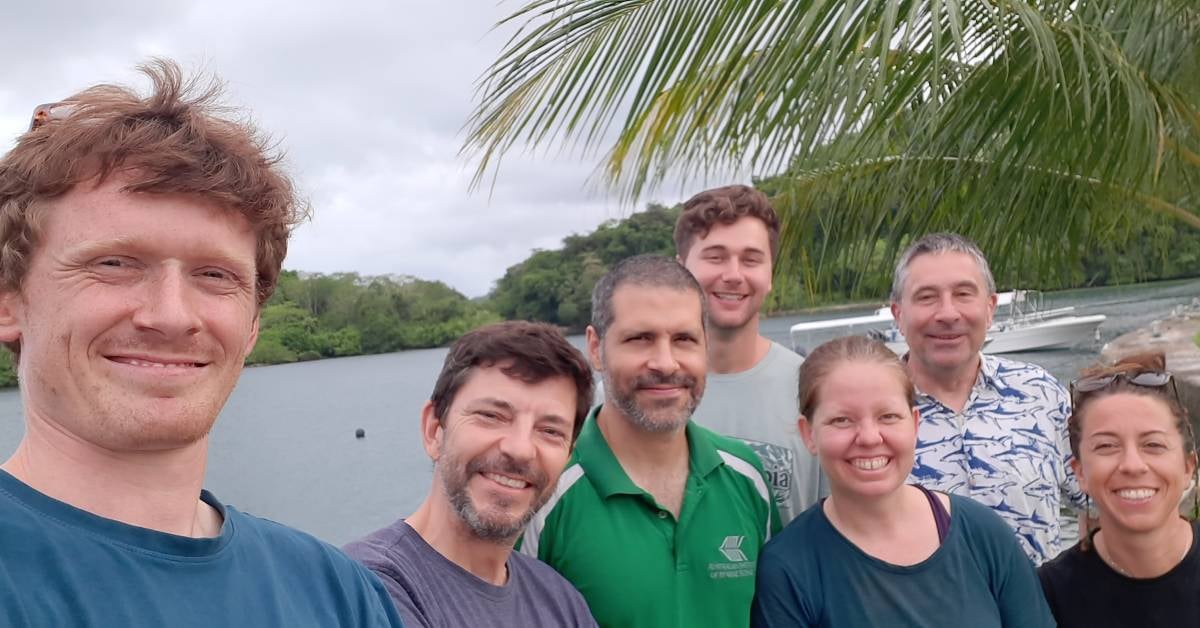
Some members of the Coralassist Lab team. Credit: Liam Lachs
You might also like:
- Discover the press release: Coral reef science must adapt for a chance to outpace climate change
- Find out more about the work of Dr Juan Ortiz, Australian Institute of Marine Science (AIMS)
- Explore the work of Dr James Guest, Reader in Coral Reef Ecology at Newcastle University and Principle Investigator at Coralassist Lab
- Explore the work carried out by Dr Adriana Humanes, Research Associate at Newcastle University’s School of Social Sciences
- Learn more about what the team are doing to research of the global challenges facing coral reefs at Coralassist Lab
- Explore the research paper: Humanes, A. et al. (2026) ‘Accelerating coral assisted evolution to keep pace with climate change’, Nature Reviews Biodiversity. Available at: https://doi.org/10.1038/s44358-026-00147-z
- Read the blog: Could selective breeding help reduce coral bleaching and mortality?
- Read the blog: How we’re working to preserve and protect our coral reefs
- Read the blog: Pacific coral reef shows potential historic increase in climate resistance
