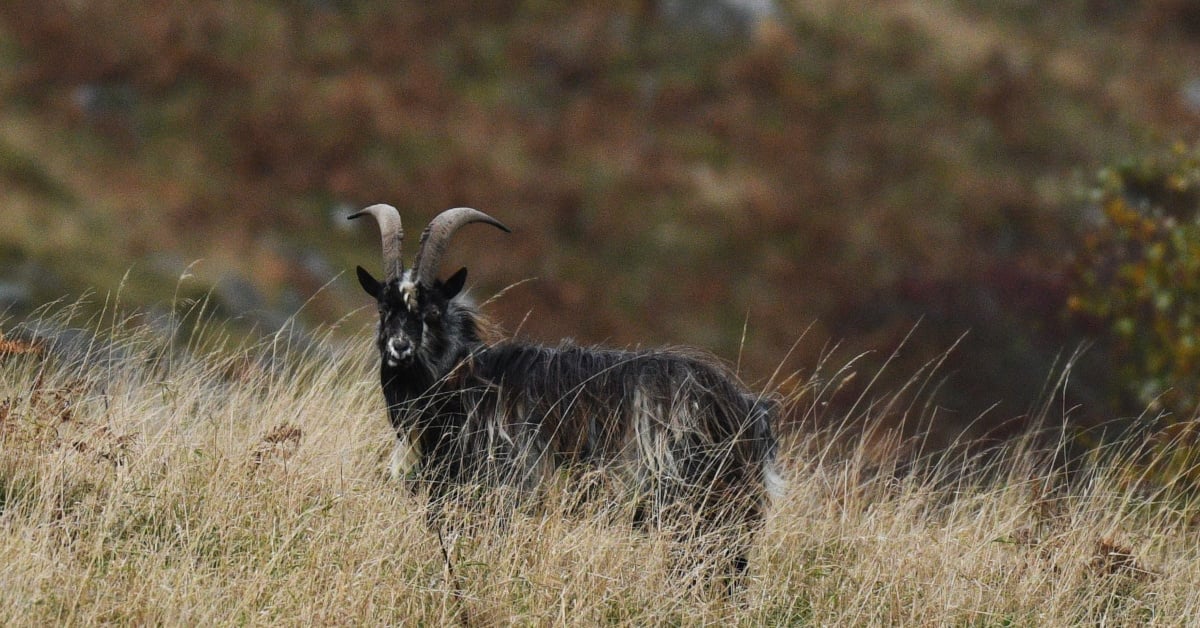
Researchers from Newcastle University have completed the very first assessment of the diversity and origins of the Cheviot goats: a genetically unique breed of goats found within Northumberland National Park.
This new research aims to prompt a re-evaluation of Cheviot goat conservation, and the practices used to control their wild populations. Read on to find out more.
Contents:
- Native and feral animals in the UK
- The Cheviot goats of Northumberland
- The study – an assessment of goat genetics
- Preserving the future of the Cheviot goat
Native and feral animals in the UK
From native wildlife to feral, wild, and domestic livestock breeds, the United Kingdom boasts a broad range of animal species. The UK has one of the richest native Animal Genetic Resources populations in the world consisting of 121 native breeds (of cattle, pigs, sheep, horses, and goats), 102 of which are listed in the Native Breed at Risk register. In addition, subpopulations of livestock species exist under the 'breed' concept and contain unique genetic material that can be used for the sustainable development of the livestock sector.
Current UK government legislations set out different levels of protection for wild animals, dependent on their classification and status. However, feral animals across the UK living a 'wild' existence are under no legal protection. This poses a problem, as some native breeds only exist as small isolated feral populations.
The Cheviot goats of Northumberland
Native goat breeds have historically contributed to supporting rural economies in the UK and are still widely valued by local communities as a 'living link' to their cultural and historical heritage.
Goats were introduced to the British Isles around 6,000 yrs ago by Neolithic settlers. Globally, native goat breeds have been studied to understand their genetic diversity and adaptations. However, little is still known on the origins of feral goat populations across the UK. Some of the existing feral herds are thought to consist of British primitive goats, defined as the 'original and unimproved goat breed of the British Isles, shaped largely by its environment and not selectively bred for certain characteristics' (British Primitive Goat Research Group 2025).

A herd of Cheviot goats in Northumberland National Park. Credit: Sampurna Roychoudhury
One of the feral populations believed to have descended from British primitive goats are known as the Cheviot goats: a distinct breed found within Northumberland National Park. According to local folklore, the goats – now recognised by DEFRA as a 'Native Breed at Risk' and designated additional recognition by the Rare Breeds Survival Trust in 2024 – were originally farmed by the monks of Lindisfarne in the Cheviot Hills and abandoned during a Viking invasion in 793 AD. However, there is no historical evidence to support this story.
The Cheviot goats have largely been neglected, accused of damaging native woodland, and treated as a non-native invasive species. As a result, the goats were culled to reduce the population to a size deemed 'manageable' by local authorities and landowners. Modern management of the Cheviot goats emphasises rehoming rather than culling to maintain numbers – however, these past practices have contributed to several severe population bottlenecks, which at its lowest consisted of only seven adult females in 1961.
Ongoing conflict with land management practices continues to drive many other isolated feral goat populations to dangerously low numbers, ultimately raising conservation concerns. Small, isolated populations are prone to inbreeding which over time leads to the loss of genetic diversity: however, it is unclear whether inbreeding depression is a looming threat for the Cheviot goats.
Introgression – or cross-breeding – between Cheviot goats and free-ranging modern domestic breeds is also a potential concern, and several studies have detected introgression between modern domestic and wild breeds. This could lead to the loss of the unique genetic components responsible for their local adaptation, affecting their genetic integrity and threatening genetic extinction. On the other hand, introgression can also enhance genetic diversity in species or populations that have low genetic variability. This could provide some evidence that genetic mixing between previously isolated populations can help relieve inbreeding, and translocating individuals can be a potentially effective population management strategy. It is therefore vital that a genetic assessment of the Cheviot goats is carried out.
The study – an assessment of goat genetics
The results of this study – the first of its kind focused on Cheviot goats – aim to help inform and shape future population management strategies of the Cheviot goats and other feral/wild goat populations across the UK.
Shared ancestry
Our researchers characterised the genetic diversity and population structure of 20 Cheviot goats using data generated from the GeneSeek Genomic Profiler Goat 70 K assay. This data was then compared against publicly available data from other goat breeds in the AdaptMap project and other studies. This helped to reveal their genetic relationship to other breeds and uncover traces of their origins. They also investigated the degree of inbreeding within the Cheviot goat population and tested for potential genetic admixture (interbreeding with other goat breeds).
The analyses showed that the Cheviot goats form a well-supported clade – or group with a common ancestor – with the Irish breeds as sister taxa. This is consistent with a previous study which revealed a similar pattern for historical samples of feral British and Irish goats using mitochondrial DNA. Included in the study were two feral goats that originated from Kielder, that date back to at least the 1960s. Additionally, a more recent study using ancient DNA obtained from the petrous bone of a Late Bronze Age goat from Potterne in Wiltshire also showed high affinity with the breed from Ireland.
In conjunction with previous studies, our results suggest a potential history of shared ancestry between the Cheviot goats, the Irish breeds, and perhaps other feral goats across the United Kingdom that predates the Bronze Age, and even as far back as the Neolithic, when goats were first introduced to both Britain and Ireland.
Admixture
Interestingly, this study did not find any evidence of either historical or recent admixture in the Cheviot goat population, and migration edges were never inferred in the Cheviot goat population across all tested models. This pattern indicates a lack of strong or recent new genetics introduced into the Cheviot breed.
'The absence of signs of genetic introgression shows that, despite the Cheviot goats having lived as a feral population, there is a lack of evidence to indicate intermixing with other domestic breeds.'
While we did not detect any traces of admixture, this interpretation should be approached with caution. The population structure for the Cheviot goats may instead be driven by the effects of inbreeding or strong genetic drift, which may have erased genetic signatures of past demographic events. One caveat in our study is that we were only able to examine the genes of 20 individuals from the College Valley herd, so it is possible that other goats may be admixed even if our sampled individuals were not. To compensate for this, we examined the genes of individuals that represented the full breadth of coat colours in the Cheviot goat population, as it was previously determined that coat colour can be used to indicate admixture.
Previous studies have inferred potential migration events leading to admixture, and have found genetic components of Scandinavian origin in the Old Irish and Bilberry goats that were estimated to have introgressed approximately 1,100 yrs ago. In contrast, such patterns from our analyses were not observed in the Cheviot goats. The estimated time of introgression in Irish goats coincides with a period characterized by Viking raids and the subsequent establishment of Viking settlements in Britain and Ireland, transporting with them various livestock animals. Existing genetic and archaeological evidence further highlights extensive human and livestock migrations between Scandinavia, Britain, and Ireland during the Viking Age. These migrations introduced goats into Ireland and are most likely responsible for the detected Scandinavian genetic signature in the Irish breeds.
'The sampled population likely consists of a genetically unique and historical breed of goats and therefore should be considered for protection.'
Genetic diversity
Genetic diversity plays a crucial role in the survival and adaptability of species and populations. The maintenance of high genetic diversity in native breeds is especially important as this may prevent the loss of the unique genetic components exclusive to those regional variants.
The 20 Cheviot goats sampled from College Valley herd exhibited very low levels of within-population genetic diversity relative to other breeds in the global dataset, except the Icelandic goats. We found evidence of very recent inbreeding taking place, in addition to more historical inbreeding, and indicators of a population bottleneck.

Icelandic goats provide another example of isolated island populations.
These results are not unexpected. Historical records have suggested the College Valley herd persisted at low numbers since the mid-1900s and experienced multiple population bottlenecks during this period. Low genetic diversity associated with high levels of inbreeding are also typical characteristics of island populations. This partially explains the higher levels of inbreeding in both the Cheviot and Icelandic goats given their long history of isolation and small population sizes.
Despite the substantially high levels of inbreeding, there are no immediate signs to indicate the expression of harmful traits caused by inbreeding depression in the Cheviot goats, and it is possible that the Cheviot goats have been purged of lethal recessive genes. However, it may also be possible that the issue of inbreeding depression may not have manifested to observable levels.
Preserving the future of the Cheviot goat
This study represents the very first assessment of the genetic diversity and origins of the Cheviot goats and identified the feral population of Cheviot goats from College Valley as a unique and historical breed that is distinct to other European goat breeds. Further investigation into the genetic architecture of the Cheviot goat population revealed an overall low genetic diversity associated with high levels of inbreeding.
'The resilience [of the Cheviot goat breed] offers a valuable and rare opportunity to investigate genetic signatures of natural selection, on a [...] population that has remained largely untouched by artificial selection.'
Due to the lack of scientific evidence on the origins and genetic structure of feral goat populations in the UK, creation of population management strategies has been restricted. Periodic culling continues to be the standard approach when it comes to controlling feral goat numbers, and there have been attempts at using more innovative strategies, such as the use of immunocontraceptive vaccines to reduce female fertility in the feral Great Orme goats in Wales. Translocationing individuals between other known feral British primitive goat populations may help relieve inbreeding and enhance genetic diversity, provided genetic studies of other feral goat populations across the United Kingdom are completed. These studies would also provide critical insight into their overall genetic diversity, population structure, and origins. This would enable effective evidence-based policies and conservation measures to be formed which prioritise the protection and preservation of this unique native breed.
This study highlighted the value of this population of Cheviot goats now that modern researchers have begun to realise the genetic potential of many native breeds. These breeds can be used as a genetic resource to supplement more modern commercialised breeds: enhancing genetic diversity, improving immunity to common diseases, and adapting or mitigating for climate change.
The research team believes that further research into this population can also provide critical insights into the evolutionary consequences of unmanaged breeds, extending to other feral goat populations in the UK to determine the genetic structure of these isolated populations. This will allow for appropriate conservation and population management strategies for the preservation and protection of this unique and underappreciated aspect of UK biodiversity.
You might also like:
- read the press release: Rare wild goats in Northumberland found to be genetically unique
- read the study: Lorenz Dale Decena, Richard M Bevan, Jodie Brown, Vlatka Cubric-Curik, Aileen C Mill, Evelyn L Jensen, Old goats, new insights: Origins and genetic diversity of feral Cheviot goats, Journal of Heredity, 2026;, esag044, https://doi.org/10.1093/jhered/esag044
- learn more about the researchers involved in this study:
- Lorenz Dale Decena, lead author and Master’s student at the School of Natural and Environmental Sciences
- Dr Richard Bevan, Senior Lecturer in Zoology
- discover our world-leading research and teaching across the natural sciences through our School of Natural and Environmental Sciences

Header image credit: Sampurna Roychoudhury