Do you prefer to pay by electronic payments, or do you always keep some cash on hand? A study headed by a Newcastle University researcher has examined the surprising factors that drive our preferences for different payment methods.
We spoke to Prof Darren Duxbury, behavioural finance expert and Chair in Finance at Newcastle University Business School, about what recent survey results can teach us about the behaviours behind the use of cash versus digital payments.
Contents:
The digital pound and cashless society
According to a report by UK Finance, the use of cash as a payment method in the UK has declined by around 15% every year since 2017. In 2007, 61% of all consumer payments were made in cash. By 2022, this figure had dropped to 14%, and by 2032 is expected to fall even further to 7%. However, worries over inflation and the rising cost of living has led some people to return to using cash, giving them greater control over a more limited budget.
This changing payment behaviour, driven in part by financial innovation and associated social change, has given rise to the opportunity for the adoption of alternate currency methods such as the ‘digital pound’. This was discussed in length in Prof Duxbury’s previous blog: ‘What is the digital pound, and does the UK need it?’.
The survey
To examine the behavioural traits that influence peoples’ choices of payment method, a collaborative academic-industry research project was developed with the National Westminster Bank (NatWest). Using data from a bespoke online survey among 2,801 UK adults, the team examined the participants’ intentions to use cash compared to noncash forms of payment (i.e., electronic methods, including both debit and credit cards). They adopted a stratified sampling approach with approximately equal interlocked quotas with respect to age, gender and income (84 subgroups) to guarantee a well-balanced sample across important sociodemographics.
‘Our study is significant because it explores the behavioural drivers behind payment intentions, focusing on the factors influencing the choice between cash and electronic payments.’ Prof Darren Duxbury, Chair in Finance
Earlier studies on how people behave, like how they budget or make payments, often adopt (endogenous) measures that are part of the payment decision itself. This study instead used behavioural traits measured independently of the payment decision. The study also considered how exogenous shocks – such as security breaches and financial crises – influenced payment intentions.
This new focus offered an alternative and complementary perspective to recent studies. examining the behavioural traits that drive payment intention and shocks that shift these.

There are multiple factors at play that influence our decisions to use card over cash - or vice versa.
Influential factors
The survey focused on mental accounting and budgeting, perceptions of money fungibility, and attitude toward loss (known as loss aversion), and how these factors influence an individual’s choice of payment method. Trait habitual behaviour (routine and automaticity) and financial literacy are also examined. The findings from the survey are as follows:
Key behavioural trait variables
Above and beyond sociodemographic factors, the study reports compelling evidence that behavioural traits, such as loss aversion, trait habit and financial literacy, shape payment intentions, though the unique influence of mental budgeting and money fungibility are subsumed by these other behavioural traits.
Respondents who scored highly on the loss attitude scale – that is, those exhibiting loss aversion – intend to make more use of electronic payments. Those who scored low on the scale are associated with a higher intention to make use of cash as a payment method. Those individuals most likely to feel the ‘pain’ of paying in cash limit their exposure to such pain by selecting electronic payment means over cash.
Financial literacy measures an individual’s financial knowledge or acumen and as such might impact payment method intention. Respondents with high financial literacy intend to use electronic payments more so than those with low levels of financial literacy. The role of emotions toward a payment method also contributes to payment intentions: the more positive individuals’ feelings towards a particular payment method are, the more likely they are to use it.
'The study finds that financial literacy is a positive and highly significant determinant of the intention to pay.' Prof Darren Duxbury
Exogenous shock
Exogenous shock refers to an external factor or upheaval that can change established behaviour, such as security breaches or financial crashes. In 2020, the COVID-19 pandemic impacted all aspects of economic life across a broad range of household and corporate contexts, ranging from bank branch lending to stock investing.
The research shows that shocks to economic circumstances and security breaches lead to changes in payment method intention. Higher loss aversion is associated with a stronger switch towards cash following shocks to economic circumstances and security breaches. In the event of a security breach, individuals high in financial literacy – and therefore more likely to use electronic payments – have a higher tendency to switch towards cash. Evidence also supports shifts away from contactless payments in the face of a security breach, thus demonstrating increased security risk associated with electronic payment methods.
Transaction sizes
Sociodemographic, financial, and behavioural factors weren’t the only variables at play. The team observed a shift in payment intention when compared with the size of the transaction. This supports longstanding evidence that payment method choice is impacted by transaction value.
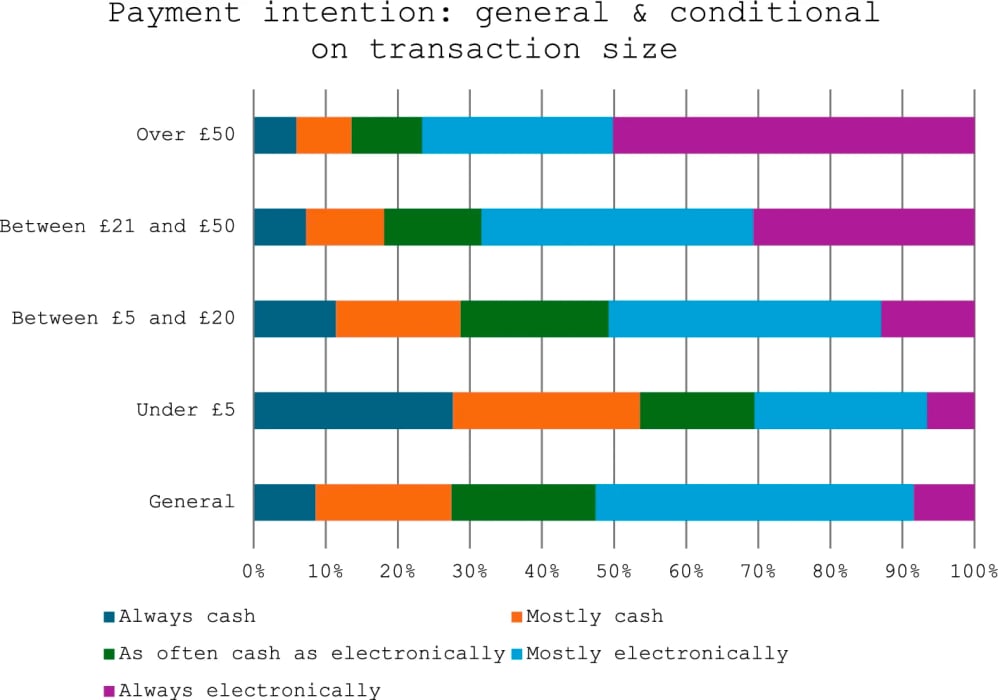
Percentage breakdown of payment intention: general and conditional on transaction size.
As seen in the chart above, the dominant category for transaction values under £5 is ‘always cash’. This category declines as the transaction size increases. The reverse is true of the ‘always electronically’ category, the percentage of which increases with transaction size and is the dominant category for transaction values over £50.
Interestingly, the research shows a shift in how the behavioural traits explain intentions to pay as transaction size varies:
- high levels of loss aversion are associated with lower intentions to use cash as transaction sizes increase
- the influence of trait habit switches at low transaction sizes, with routine associated with cash payments and automaticity with electronic payments
- as transaction size increases, financial literacy is associated with a lower intention to use cash and higher intention to use electronic payment methods, while the influence of emotions diminishes as transaction size increases
Therefore, as transaction values increase, affective feelings towards a particular payment method matter less, while financial acumen plays a more important role.
The future of cash payments
The survey found evidence of loss aversion being a major factor in peoples’ decision to use cash, with the perceived ‘pain’ of paying in cash compared to other payment methods increasing with transaction size. Participants made more cash payments under £5 as a matter of routine, but more electronic payments under £5 as a reflection of an unconscious action. As transaction sizes shift from low to high, routine changes from being preferring cash payments to electronic payments. Meanwhile, automaticity changes from being associated with electronic to cash payment.
By studying cognitive biases, external factors, and trait habits, the survey provided valuable insights into the statistical and economical significance of financial literacy for policymakers and the cash industry. With government policies around the world tackling financial illiteracy in the general population, this could prove a valuable way to forecast future cash demand, and must be considered when modelling future payment methods.
Findings from the study will be of interest to the wider public, charities and consumer representatives with respect to the availability and access to payment methods. The behavioural insights support the view that cash plays an important budgetary role for many in society, including but not limited to, those consumers with low levels of financial literacy. The importance of trait habitual behaviour in consumer payment method intention suggests that some sections of society will likely resist payment method innovation, although evidence in relation to exogenous shocks supports the view that payment intention habits are susceptible to change.
Despite the emergence of digital payment methods, the team concluded that cash will remain an accepted – and in some cases, preferred – means of payment.
You might also like:
- read the study: Duxbury, D., Verousis, T. & Marsh, D. Behavioral drivers of intentions to use cash: UK survey evidence. Financ Innov 12, 98 (2026). https://doi.org/10.1186/s40854-026-00919-8
- explore our articles:
- read Prof Duxbury’s article contribution to North East Times Magazine
- learn more about Prof Darren Duxbury, Chair in Finance at the Newcastle University Business School
- discover how research at the Newcastle University Business School helps shape policies which aim to solve the pressing issues of today and tomorrow
