When researchers want to improve health outcomes, the solution often leans towards education and sharing better information earlier. But what happens when the barriers to healthcare aren't simply a lack of advice, but deeply embedded social beliefs, cultural narratives, and stigma?
That's the question behind A Canvas for Change, a collaboration between researchers at Newcastle University, Aga Khan University, and Kenyan creative practitioners that explores how theatre and film can challenge perceptions of neurological conditions in coastal Kenya.
Contents:
- Art as communication
- When information isn't enough
- Putting lived experience centre stage
- From stage to screen
- What can researchers learn from creative methods?
- Research with impact beyond the project
Art as communication
The project brings together expertise from global public health, film and community engagement to investigate a simple but powerful idea: people are often moved by stories in ways that facts alone cannot achieve.
In doing so, it offers an example of how creative practice can contribute to addressing complex societal challenges. By bringing together researchers, artists and communities, the project demonstrates how creative approaches can open up conversations that traditional forms of communication may struggle to reach.
When information isn't enough
In Kilifi, Kenya, neurological conditions such as epilepsy and Parkinson's disease are often misunderstood. In some cases, symptoms may be linked to supernatural explanations or spiritual possession, creating barriers to social inclusion and access to healthcare.
‘Traditional public health messaging often falls short in addressing these deeply rooted cultural beliefs. Information alone is rarely enough to change behaviour when that behaviour is tied to complex social frameworks.’ – Dr Tash Fothergill-Misbah, Senior Research Associate in Global Public Health at Newcastle University
The inability to address such challenges through conventional public health communication alone presents a significant challenge for researchers working in global health.
Putting lived experience centre stage
The Canvas for Change team made the decision to work alongside communities, rather than simply communicate to them.
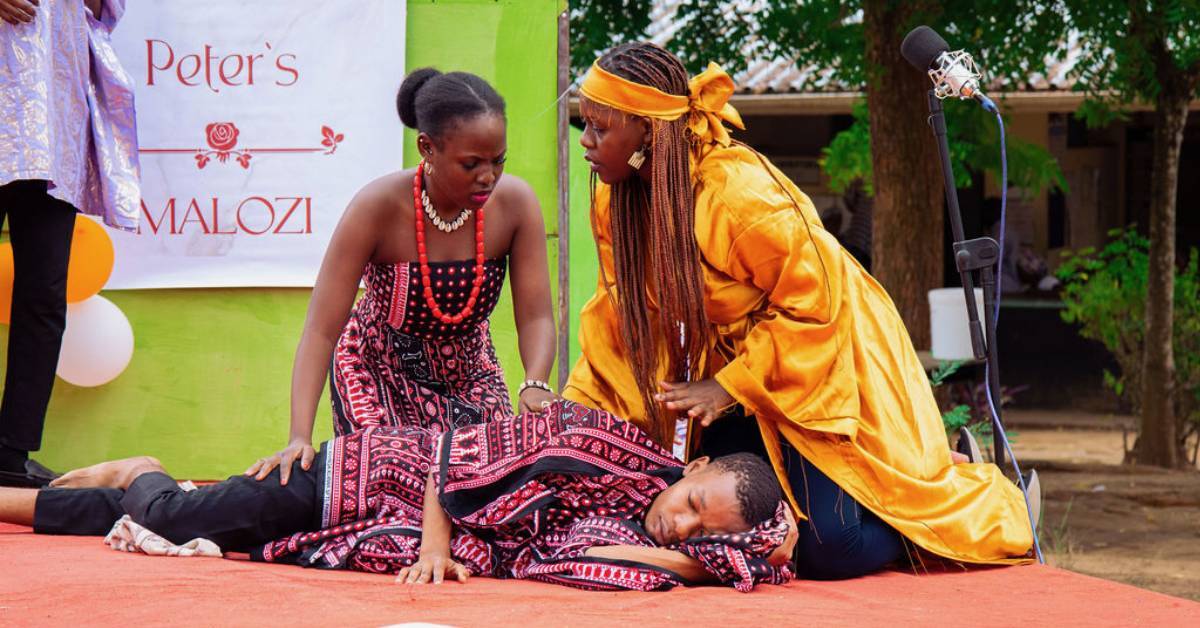
Partnering with Kenyan creative organisation Jukwaa Arts, researchers collaborated with people living with Parkinson's disease and epilepsy to develop theatre performances rooted in their lived experiences.
Rather than beginning with a script, the creative process started with conversations. Workshops created space for participants to share experiences of stigma, healthcare, and everyday life. These stories became the foundation for two theatre productions, which were continually refined through participant feedback and co-production over a six month period.
‘We worked very closely with the Kenyan creative team and members of the community in Kilifi to co-produce the scripts. The experiences of stigma surrounding both neurological conditions were shared across a series of workshops, and the script continued to be developed through script sharing and participant feedback.’ – Dr Alastair Cole, Reader in Film Practice and documentary filmmaker at Newcastle University
This collaborative approach was central to the project's success, and the resulting performances were staged for more than 300 community health workers across Kilifi.

Group activity with community health promoters.
From stage to screen
The impact of the project did not end with the play’s performance. The theatre productions were later adapted for film and now form the basis of Vunja Unyanyapaa (Break the Stigma), a public awareness campaign that combines storytelling, health information, and community dialogue.
At the heart of the campaign is a clear message. Epilepsy and Parkinson's disease are medical conditions, not curses or punishments, and people living with them deserve dignity, support and inclusion.
By placing lived experience front and centre, the campaign seeks to create opportunities for reflection and conversation, helping communities engage with neurological conditions through empathy as well as information.
The team has also produced a documentary, Zaidi Ya Imani (Beyond Beliefs), which follows the project's development and process of co-production, and explores the wider questions surrounding stigma, healthcare, and community engagement.

Duocumentary film poster for 'Zaidi Ya Imani' ('Beyond Beliefs')
What can researchers learn from creative methods?
For early-career researchers, A Canvas for Change offers an interesting example of what interdisciplinary research can look like in practice.
The project sits at the intersection of public health, film, performance, and community engagement. Rather than viewing creative practice solely as a way of communicating findings, the team has used it as a research method in its own right.
This approach recognises that research impact is often as much about relationships, participation, and understanding as it is about evidence generation.
Creative methods can help researchers access perspectives that may otherwise remain unheard, opening new ways of exploring complex social challenges.
A Canvas for Change also highlights how creative approaches can help researchers engage with questions that are deeply rooted in people, communities, and place. By combining expertise from public health and the creative arts, the project demonstrates how creativity can be used not just to communicate research, but to co-produce knowledge, amplify lived experience, and support meaningful social change.

Community setting for theatre performances.
Research with impact beyond the project
The influence of the work is already extending beyond performances and films.
Researchers, policymakers and community stakeholders have collaborated on the development of a national partnership roadmap for neurological disorders, aimed at reducing stigma surrounding neurological conditions in Kenya. The roadmap is currently undergoing ratification through the Kenyan Ministry of Health.
For the team here at Newcastle, this demonstrates the potential of bringing together academic expertise, lived experience, creative practice and policymakers.
By combining research, creativity and community participation, A Canvas for Change raises an important question for researchers everywhere. If changing minds requires more than facts alone, what role might creativity play in creating lasting social change?

Policy workshop with Ministry of Health and AKU Brain and Mind Institute representatives, and the First Lady of Kisumu County.
You might also like:
- read the news story: Newcastle colleagues using art to change thinking
- find out more about Dr Tash Fothergill-Misbah, Global Public Health researcher and award-winning documentary film producer
- watch Tash’s 2023 documentary, ‘Shaking Hands with the Devil’
- watch Tash’s 2024 documentary, ‘Uhuru’
- find out more about the work of Dr Alastair Cole, Reader in Film Practice and School Director of Impact
- see more about Alastair’s other films at Tongue Tied Films
- find out more about the project funder, The British Academy
- curious to know more? Read the blog: Witchcraft and demons: perceptions of Parkinson’s disease in Africa
- discover how we’re unlocking the power of culture and the creative industries to shape vibrant, resilient communities
