-2.jpg)
Early-career researchers are exploring whether artificial intelligence could play a role in helping conserve the UK's endangered red squirrel.
Contents:
- Why are grey squirrels a problem?
- Bringing AI and conservation together
- Teaching computers to recognise squirrels
- From recognising squirrels to making decisions
- Learning beyond the classroom
- A promising proof of concept
- Looking ahead
Red squirrels are one of the UK's most recognisable native mammals. Once a common sight across Britain, their numbers have declined dramatically over the last century, and the species has disappeared from much of its former range.
Today, surviving populations are concentrated in a number of important habitats, including northern England, Northern Ireland, the Isle of Anglesey, the South Coast islands, and with over 75% of the population being found in Scotland.
Why are grey squirrels a problem?
One of the biggest issues facing red squirrel conservation is the presence of the non-native grey squirrel. Grey squirrels were introduced to Britain from North America between the late nineteenth and early twentieth centuries and are now established across much of the country.
Grey squirrels compete with red squirrels for food and habitat, but they also also carry the squirrelpox virus. While the disease rarely affects grey squirrels, it’s often fatal to red squirrels and has contributed significantly to their decline.
As conservation organisations continue to explore new approaches to protecting red squirrel populations, researchers, volunteers, and industry partners are increasingly looking at how technology could aid their efforts. One promising area is artificial intelligence (AI), which has the potential to help identify species automatically and support wildlife monitoring and management activities.
Bringing AI and conservation together
At the National Innovation Centre for Data (NICD), a group of early-career AI trainees recently worked with product design consultancy E3 Design to investigate whether computer vision technology could help distinguish between red and grey squirrels automatically.
Existing grey squirrel population management approaches often rely on trapping and culling, which can be resource-intensive and difficult to sustain, particularly in volunteer-led conservation efforts.
However, current research is being carried out to develop a contraceptive that can be given to grey squirrels.
E3 Design and the team were faced with the challenge of designing an automated feeder system to aid with giving these contraceptives. The main obstacle would be how to ensure that only grey squirrels were offered the contraceptive.
From there, the team came up with the question: could AI accurately identify which species of squirrel was present in front of a camera, and support future conservation measures?
'Getting to work on real problems, as opposed to the lab-based work we did at university, has been really fulfilling. It's satisfying to see how what we're doing will actually be used.' – Lucy, AI trainee
The project formed part of NICD's Department for Science, Innovation and Technology (DSIT)-funded AI traineeship programme, which gives aspiring data scientists and AI specialists opportunities to work on real-world challenges with external organisations.
Teaching computers to recognise squirrels
Trainees worked with thousands of images extracted from trail camera footage supplied by E3 Design. The team spent significant time creating and refining a training dataset that would allow the computer to identify the red and grey squirrels.
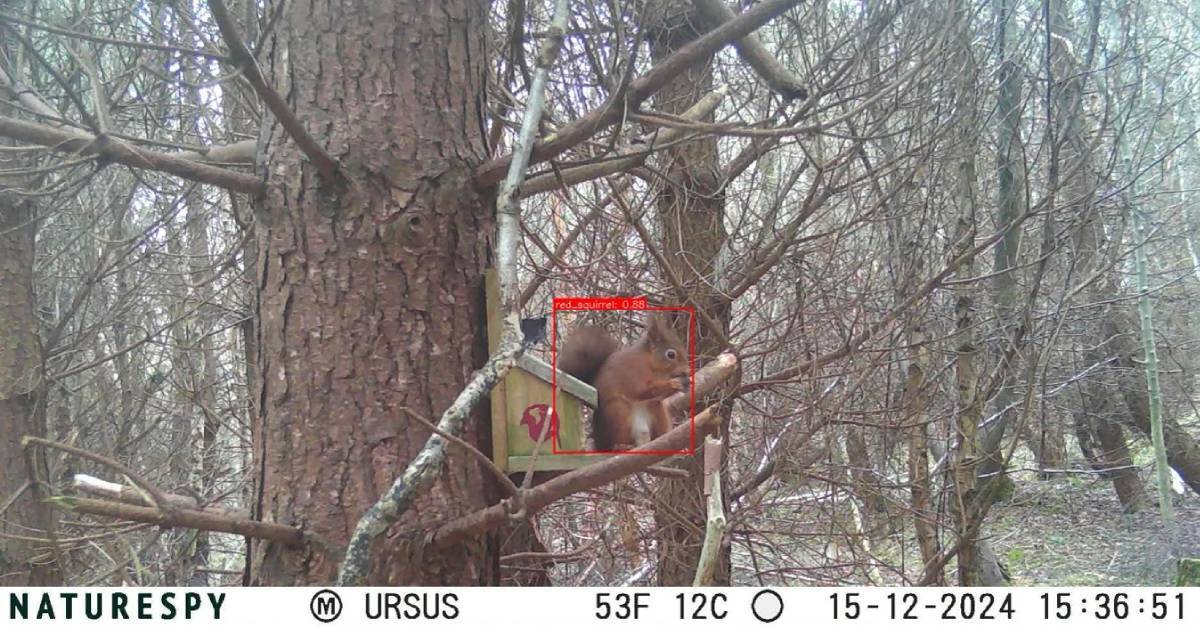
Example RF-DETR output labelling a red squirrel. Original image owned by Ian Glendenning
Images were annotated to show where squirrels appeared within each frame, creating the labelled data needed to train machine learning models. While automated tools helped identify animals in the footage, human review remained essential to ensure accuracy.
The trainees evaluated a range of object-detection approaches to aid with data annotation before turning to MegaDetector, a tool specifically developed for analysing wildlife camera imagery to identify whether an animal, human or vehicle is within an image. This provided a stronger starting point for identifying animals in the footage and helped the team build a more reliable dataset. Images were annotated to show where squirrels appeared within each frame, creating the labelled data needed to train machine learning models. While MegaDetector aided in identifying animals in the footage, human review remained essential to ensure accuracy and update labels from 'animal' to the appropriate species.
Using this foundation, the group tested several state-of-the-art object detection architectures suitable for running on small devices, including EfficientDet, D-FINE, RT-DETR and RF-DETR, to create an object detection model capable of telling the difference between red and grey squirrels with trail-camera footage.
Following extensive experimentation, RF-DETR delivered the strongest overall performance and was selected as the final model.
From recognising squirrels to making decisions
Identifying the species was only part of the problem.
The team also explored how an automated system might respond to those detections in real time. They developed decision-making logic that analysed a sequence of recent camera frames and determined whether a feeder should remain locked or unlock, depending on the species of squirrel.
If a red squirrel appeared in the recent footage, the feeder stayed locked. If only grey squirrels were detected, the system could unlock. If no squirrel was detected at all, the feeder defaulted to a locked state.
This cautious approach was designed to minimise any risk of red squirrels accessing feed intended for grey squirrel population management.
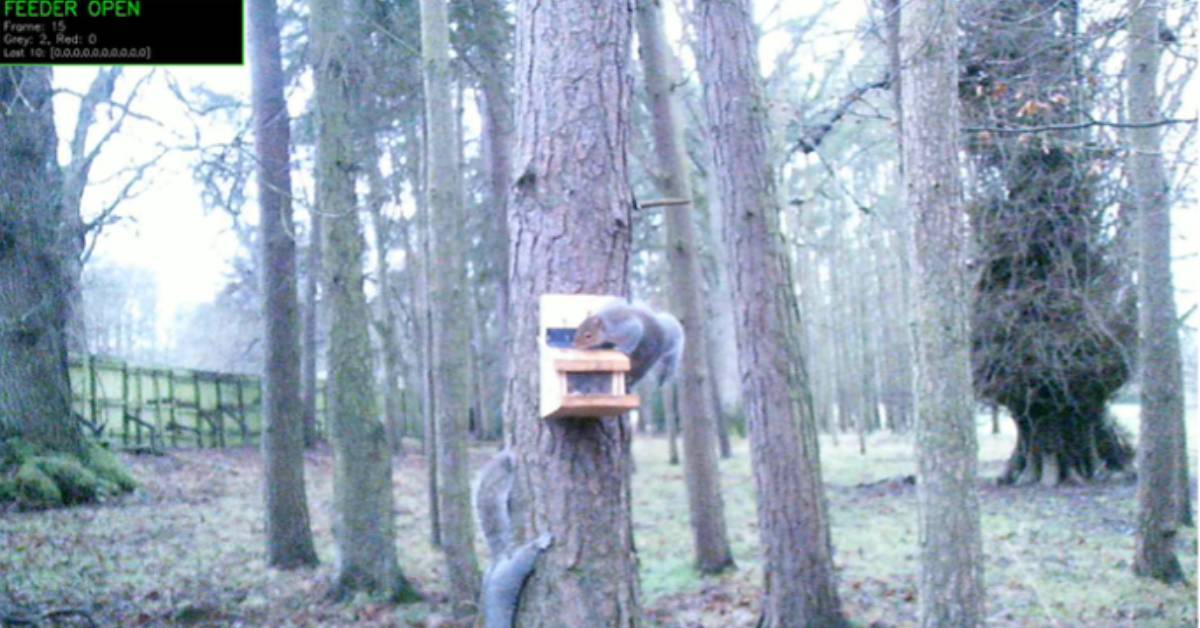
Simulated example of the feeder logic implementation. This uses the output from RF-DETR to determine when the feeder should be opened or closed. Original images owned by Ian Glendenning.
Learning beyond the classroom
For the trainees involved, the project offered more than theory and the chance to develop technical skills. It also provided experience of working with a real client, navigating practical constraints, and designing creative solutions that could have genuine societal and environmental impact.
The collaboration also included a visit to the squirrels’ natural habitats in Northumberland, helping trainees understand the operational realities behind the problem they were trying to solve and to meet many volunteers who are dedicated to red squirrel conservation.
'We went on a field trip and met the stakeholders involved. It's not just a technical exercise. Meeting the people who'll use our solution makes it feel like the project has life to it.' – Harish, AI trainee
The group collaborated regularly with E3 Design throughout the project, sharing progress, discussing difficulties, and adapting their work in response to feedback.
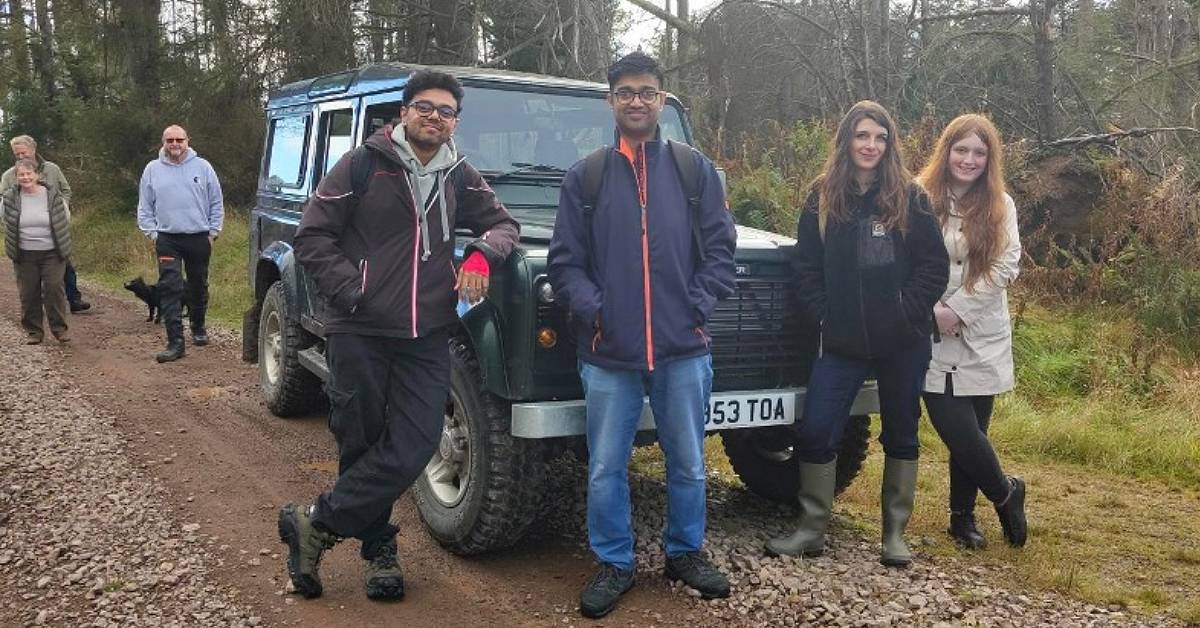
NICD trainees on a field trip in Hepple Woods, Northumberland, developing an AI solution to help protect red squirrels. They spent the day with E3 Design Ltd, the Coquetdale Squirrel Group, Bedlington Squirrel Group, Hepple Whitefield Estate, and Forestry England, gaining valuable insight into the real-world challenges of conservation in remote habitats.
A promising proof of concept
The final model achieved more than 80% accuracy on the project's test dataset, exceeding the original target of 50%.
While further development, testing, and validation would be required before any real-world deployment, the results demonstrate the potential of AI-powered wildlife monitoring systems.
The project also highlights the growing role that data science and machine learning can play in addressing environmental challenges. From species monitoring and habitat management to conservation planning, AI is increasingly becoming a tool that can support the work of ecologists, conservationists and volunteers.
Looking ahead
Protecting biodiversity requires expertise from many different disciplines, and conservation is no longer solely the domain of environmental scientists.
Projects such as this demonstrate how computer vision, machine learning, and data science can contribute to tackling real-world ecological problems while creating meaningful learning opportunities for the next generation of researchers.
For NICD's AI trainees, the collaboration offered valuable experience at the intersection of technology and environmental impact. For E3 Design, it provided a foundation for further exploration of how intelligent systems could work together with wildlife conservation efforts.
And for the UK's remaining red squirrels, it offers a glimpse of how innovation might help support their future in an increasingly complex landscape.
You might also like:
- find out more about the National Innovation Centre for Data (NICD)
- read more about the two species of squirrel in the UK
- find out more about NICD's Department for Science, Innovation and Technology (DSIT)-funded AI traineeship programme
- explore the world of design consultancy E3 Design
