Andy Burnham's first months as Prime Minister have brought a number of questions into focus about how Britain is governed. But what do our experts believe this says for the future?
In the first of three blogs, in which Newcastle University academics offer different perspectives on Burnham's first months in power, Professor Alistair Clark considers what Burnham's leadership means for party organisation, electoral politics and policy challenges – and whether his premiership could mark a more stable period of British politics.
Contents:
- Does Andy Burnham's premiership signal a more stable period of British party politics?
- Party organisation as a source of instability
- Do leaders make a difference?
- The policy challenge
- The way forward: economics and competence
Does Andy Burnham's premiership signal a more stable period of British party politics?
Andy Burnham is Britain’s seventh Prime Minister since 2015. His elevation, after Sir Keir Starmer won a record-breaking election just two years previously, is symptomatic of the instability that has infected British politics.
Is his transition from Greater Manchester Mayor to Labour Party leader and then the premiership likely to usher in a calmer period of politics in the run up to the next general election?
Let’s explore.
Party organisation as a source of instability
British electoral politics has been febrile for some time. The extent to which parties themselves have been engines of this volatility and instability is often underappreciated.
Brexit’s history – from Cameron’s 2013 promise of an in/out referendum, to the eventual Brexit deal – can be written through the lens of internal factional politics within the Conservative Party. Such factionalisation led to various leadership challenges, from Cameron to Sunak.
Labour has not been immune. Jeremy Corbyn’s leadership was riddled with factional conflict throughout. A key Starmer instinct was to purge the left, leading to disquiet within Labour, several candidates standing, and winning, as independents, and to long-term internal discontent with his leadership in office.
Burnham benefited from this internal factionalisation. An internal campaign to pressure Starmer into resigning in favour of Burnham was evident long before Burnham’s eventual victory in the Makerfield by-election.
A recent pamphlet for the thinktank Compass portrays Burnham as being on a ‘journey from Blairism to a soft left politics defined by a mix of innovative state intervention and a grasp of pluralism’ (p.10). With around 95% of the Parliamentary Labour Party (PLP) backing Burnham, his unopposed elevation to the premiership has seemed to put paid to internal dissatisfaction for the time being.
Do leaders make a difference?
Internal campaigns to promote one or other candidate to the party leadership are normally based on the hope that they will make a difference to the party’s fortunes.
They can do so in two ways; with public opinion, and with policy. Both motivations have been evident in Burnham’s rise.
With the Conservatives in the electoral doldrums, the key electoral challenge has been the rise of Reform UK.
The insurgent party, and its UKIP predecessor, has drawn considerable support from formerly Labour voting areas. It has led in the polls from April 2025, posting some remarkable performances in local elections in 2025 and 2026. Pollsters are seriously talking about Reform UK’s potential to become the next government.
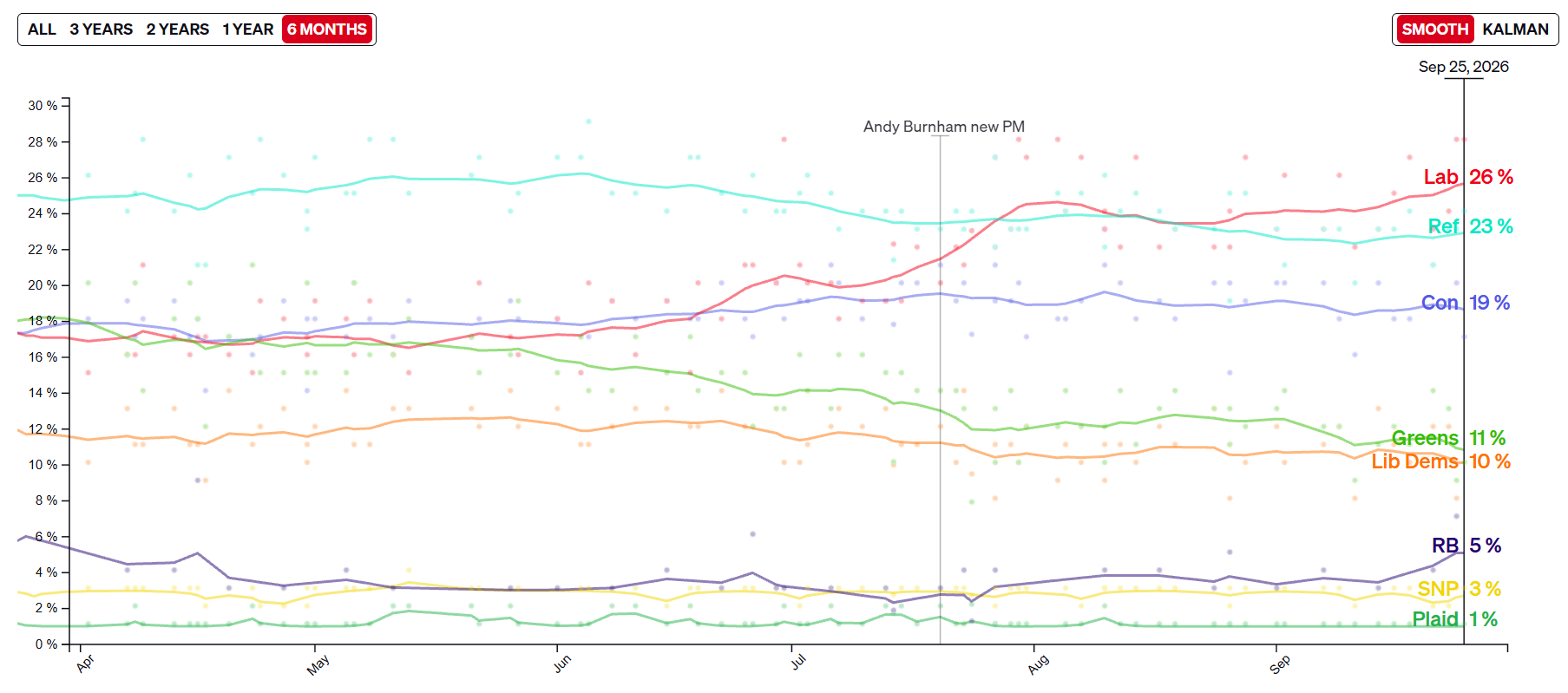
Figure 1: Politico, Poll of Polls March-Sept 2026. Credit: Politico
Figure 1 shows that Burnham becoming Labour leader has seen an upturn in the party’s polling fortunes. There has been a ‘Burnham bounce’. This has calmed Labour Party nerves.
However, this bounce is shallow, and has mostly taken place over the quieter summer months during the parliamentary recess. The test will be whether this can be sustained through party conference season, and the gap between the two parties extended.
What has been different about recent British politics has been that several parties have been on a similar vote-share in opinion polls, and others not that far behind. In a plurality electoral system, it is easier for smaller parties to pick up seats in specific localities.
Liberal Democrats, Reform UK and the Greens have all benefited from this.
In this regard, Burnham’s leadership does not really seem to have moved the dial. Labour, Reform UK and the Conservatives all remain on around 20%, while the Greens and Lib Dems are in the teens. The volatility of five party politics is here to stay, Burnham or not.
The policy challenge
In policy terms, the ‘vibes’ around Burnham’s leadership have been different.
Burnham’s emphasis on devolution is new. Eye-catching statements on bus fare caps, ending rough sleeping, cutting business rates and VAT on energy bills, coupled with reversing other Starmer policies such as digital IDs, early prison releases, have formed part of a ‘policy blitz’.
Major policy challenges persist. The top three issues for voters in August’s IPSOS monthly issues index are, in order, immigration (42%), the economy (32%) and inflation/prices (21%). The economy remains stagnant and 61% think it will get worse over the next twelve months. Climate change is now joint fifth, behind health and alongside housing.
Burnham’s room for manoeuvre is limited. Inflation is expected to rise in the coming months. Government borrowing has become more expensive. Demands from defence continue to increase as security challenges proliferate. Climate adaptation will be costly, while infrastructure is creaking. Immigration continues to provoke public order and public policy challenges.
All increase demands on spending, yet government’s ability to do so will depend on either tax rises, spending cuts or reprioritisation of programmes. A clearer sense of the Burnham government’s priorities is unlikely to emerge until Chancellor John Healey’s budget on 28th October, the 10-year plan expected in November, and the subsequent spending review.
Against this backdrop, Burnham’s statement at PMQs on 9th September seems significant.
‘We do everything to support our national security, but it cannot come at the expense of social security. Having strong national security also depends on resilience in our communities. We on the Labour Benches will not be forced to choose between the two.’ – Andy Burnham
Labour’s backbenchers, particularly those which pushed for Burnham to become leader, will be pleased to hear this, markets much less so. This suggests a period of relative internal party stability ahead, while at the same time the government is likely to continue being buffeted by external demands.
The way forward: economics and competence
The core areas of party competition heading to the next general election seem to be returning to more familiar economic issues after the ‘kick the rascals out’ character of the 2024 contest, and the Brexit-oriented 2017 and 2019 elections.
Burnham’s ‘growth in every postcode’ mantra acknowledges this, and Conservative leader Kemi Badenoch has also reshuffled her economic team.
Election studies have repeatedly shown that a key factor in electoral victory is leadership competence and delivery. Both have been in short supply in recent years. Whatever his other priorities, if Burnham acts on this, this should set the foundation for the next general election campaign expected at latest by 2029.
You might also like:
- read more from Professor Clark: Alistair Clark, Louise Thompson, Stuart Wilks-Heeg, Introduction: A record-breaking election, Parliamentary Affairs, Volume 78, Issue Supplement_1, August 2025, Pages 1–8, https://doi.org/10.1093/pa/gsaf019
- find out more about Professor Alistair Clark, Professor of Political Science
- explore Newcastle University’s School of Geography, Politics, and Sociology
