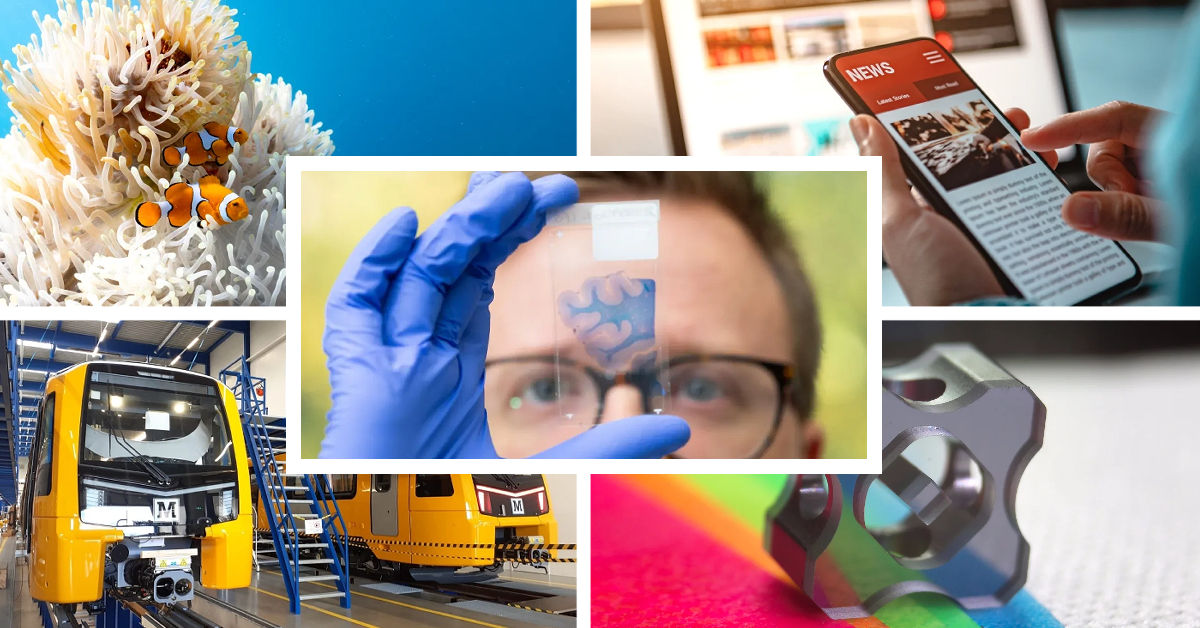
2025 was a year of great accomplishments for Newcastle University's research community.
From breakthroughs that deepen our understanding of the environment and the power of data, to discoveries improving health, supporting communities, and driving medical innovation, our researchers are making ground-breaking progress.
Read on for a snapshot of our work shaping healthier lives, protecting our planet’s future, and finding solutions to some of the world's most pressing challenges.
Contents:
- Helping people live healthier, happier, longer lives
- Ensuring there is enough for everyone, forever
- Enriching the future through arts and culture
- Helping to build sustainable communities fit for the future
- Unlocking the power of data to discover solutions and drive innovation
- Innovations and partnerships
- Research for the future
Helping people live healthier, happier, longer lives
In 2025, we made significant breakthroughs in our Ageing and Health research, culminating in us receiving the Queen Elizabeth Prize for Education in recognition of our work transforming the understanding, diagnosis, and care of people with Dementia with Lewy bodies (DLB). From a pioneering IVF technique that reduces the risk of serious inherited disorders to engineering tissue to heal the human body, these stories highlight how we're helping to improve health and wellbeing for all.
Royal recognition for dementia research
At Newcastle University, our researchers have spent decades advancing the understanding of Dementia with Lewy bodies (DLB).
Their pioneering work has redefined DLB as a distinct and common cause of dementia, improving diagnosis and treatment worldwide. This dedication has now been recognised with the prestigious Queen Elizabeth Prize for Higher and Further Education.
We spoke to Nigel Thomas from South Tyneside and his wife Heather, who shared their experience of Nigel’s diagnosis and the care they have received.


Eight babies born after Mitochondrial donation in groundbreaking IVF procedure
In a major medical breakthrough, eight babies in the UK have been born free from serious inherited disorders thanks to mitochondrial donation IVF.
The technique, developed by a team at Newcastle University and the Newcastle upon Tyne Hospitals NHS Foundation Trust, replaces faulty mitochondria with healthy donor ones, preventing the transmission of rare but often fatal genetic diseases.
This cutting-edge approach offers new hope to families previously facing the risk of incurable mitochondrial DNA diseases.
Ensuring there is enough for everyone, forever
From clownfish that shrink for survival, to understanding why glaciers worldwide should be preserved: our One Planet research highlights how our experts are addressing environmental challenges to work towards a better and fairer world. Scroll through to read more One Planet stories:


Shrinking Nemo - the unusual way clownfish adapt to survive
Animals are the masters of adaptation within rapidly changing environments, especially when faced with the risks of climate change. Some are known to shift to lighter colourations to absorb less heat, while others expand the size of their beaks or feet to cool down faster.
However, scientists Melissa Versteeg and Dr Theresa Rueger from our School of Natural and Environmental Sciences have observed a fascinating way that coral reef clownfish have adapted to survive heat stress while avoiding social conflict – they shrink. Read on to find out why changing their size could help these iconic fish adapt to a warming ocean.
Enriching the future through arts and culture
Our Culture and Creative Arts stories explore how arts research and practice helps us engage with the world and shape a more informed future. Whether exploring the morality behind true-crime media or preserving challenging histories for future generations, these stories reveal how arts and culture enrich experience, deepen understanding and inspire meaningful dialogue. Explore the full stories below.
.jpg?width=1200&length=1200&name=True%20Crime%201200%20x%20628%20(2).jpg)

Helping to build sustainable communities fit for the future
Whether the research stories are local or international, we're helping to develop innovative solutions to expand social and economic opportunities: from adapting local public transport by engaging with customers to the story of sailors from Beiyan in a Newcastle cemetery.


Unlocking the power of data to discover solutions and drive innovation
Our Data research allows us to glimpse into the future of technology. We're unlocking the power of data to discover solutions and drive innovation, from a podcast series all about AI to how experts are enhancing data privacy through deduplication. Swipe through the images and click to read the full stories:


From Newcastle Podcast: Artificial Intelligence
In the latest series of our ‘From Newcastle’ podcast, we explore the rise of artificial intelligence and how it’s shaping our lives.
From creativity and education to ethics and the environment, Newcastle University experts help us make sense of it all.
Innovations and partnerships
We partner with businesses worldwide to foster knowledge exchange, generate impact and overcome challenges. By bridging the gap between ideas and solutions, we provide access to world-class research, technology, and talent to help businesses grow and innovate.
Innovating outdoor gear for women
Working alongside outdoor clothing and equipment brand Berghaus, our researchers used scientific testing and analysis to help create new legwear technology that truly adapts to the female form. Our advanced sport and exercise research and testing facilities were used to carry out biomechanical modelling and physiological analysis, which helped validate and refine the product design.

From campus to company: how and why we create new businesses
Our company creation team works to transform discoveries and ideas into new companies, called spin-outs. We currently have 37 active spin-out companies, attracting £35million of investment in the last two years and creating more than 300 jobs. Learn how the team helps identify potential spin-outs, supports their creation, and helps them onto a trajectory of growth by reading this blog post.
Research for the future
We're also examining how research happens: what are the roles of the culture and systems that surround research? From creating environments where people can do their best thinking to making co-production sustainable, we’re exploring how culture, structures, and everyday practice come together to move research forward.


Looking ahead, we’ll continue to build on these efforts into 2026 and beyond: advancing knowledge, sharing insights, and driving progress through innovation and collaboration for the benefit of all.
Explore more insights
- sign up for our monthly Research News email newsletter or subscribe to Research News on LinkedIn
- discover our Centres of Research Excellence and the multidisciplinary challenge-led research they deliver
- visit our Press Office for the latest news
- listen and subscribe to the From Newcastle Podcast, bringing you the stories and people behind our research
- explore our strengths in Ageing and Health, Cities and Place, Culture and Creative Arts, Data and One Planet
- learn more about how we’re committed to building a welcoming and empowering research culture
- read about our world-class research facilities, specialist equipment and experienced staff
- explore how we work with businesses and partners to grow and innovate
